DEWALT DCF860B High-Torque Impact Driver
As an Amazon Associate I earn from qualifying purchases.
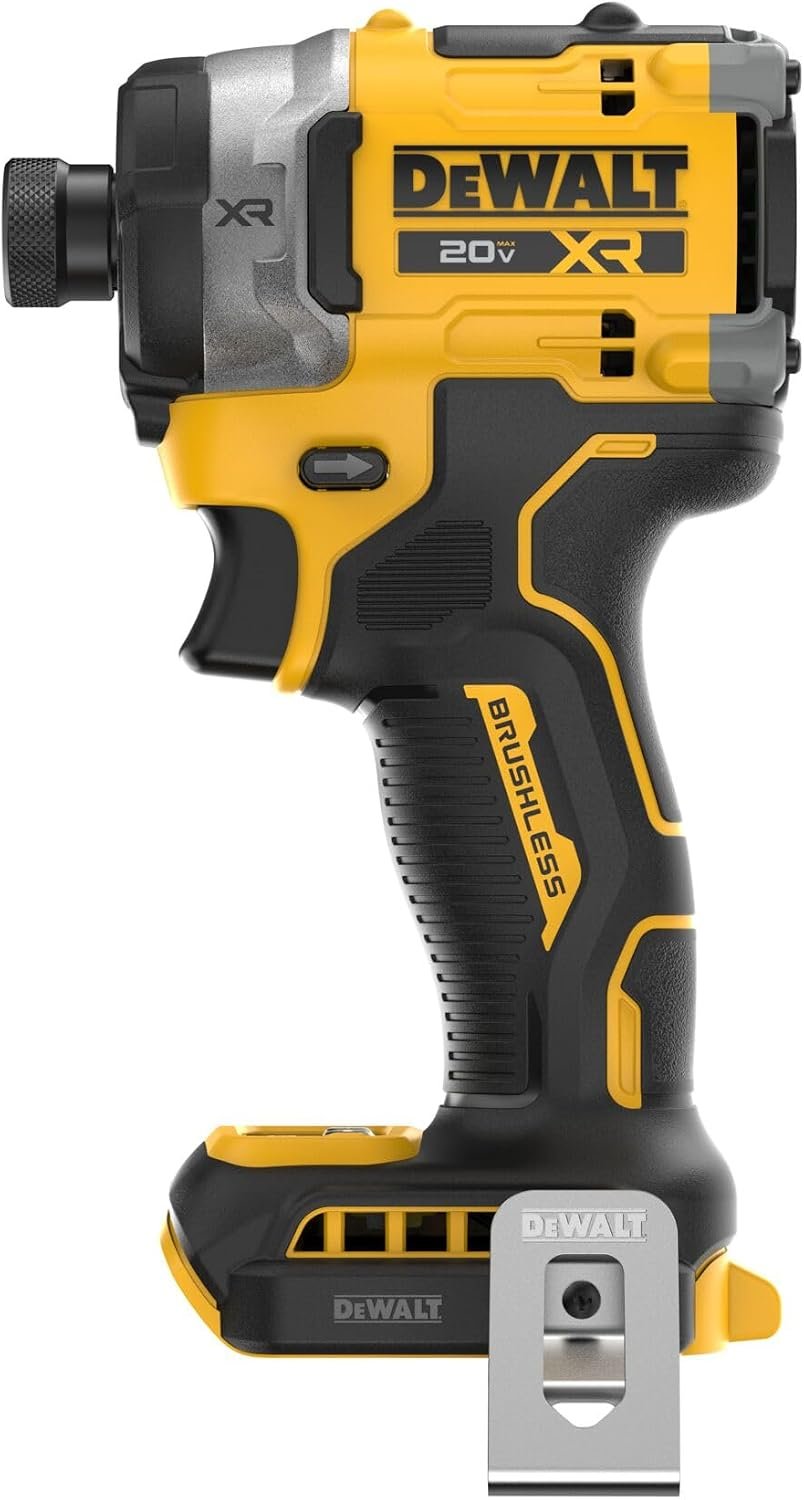
The DEWALT DCF860B High-Torque Impact Driver is built for fastening jobs where a conventional drill starts to feel slow, bulky or short on torque.
Its brushless motor delivers up to 2,500 in-lb of maximum torque, while three speed settings give you a way to tame that power when the job calls for more control. At the top end, the tool reaches 3,800 RPM, giving it the pace needed for repetitive fastening work as well as heavier structural screws and fixings.
For tradespeople already using DEWALT’s 20V MAX platform, it is the sort of tool that can spend a lot of time clipped to a belt rather than sitting in a case.
Why it works for demanding fastening jobs
The main attraction of the DCF860B is the combination of high torque and selectable speed.
DEWALT gives it three modes rather than forcing every job through one aggressive setting. Mode 1 runs up to 1,800 RPM, Mode 2 up to 2,500 RPM, and Mode 3 up to 3,800 RPM.
That matters when moving between very different fasteners.
A smaller self-drilling screw in sheet material does not need the same treatment as a long structural screw going into timber. The lower modes give you a better chance of controlling the start of the fastener, while the highest setting is there when speed and torque matter more.
DEWALT specifically says Modes 1 and 2 are optimised around commonly used self-drilling and tapping screws.
The variable-speed trigger adds another layer of control, so even within a selected mode you are not simply choosing between stopped and full speed.
What it feels like to use
An impact driver has a very different feel from a conventional drill.
The DCF860B is compact around the head, and once a suitable battery is fitted it has that familiar front-heavy but balanced cordless-tool feel. The grip is rubberised and shaped for a firm hold rather than feeling smooth or slippery.
Under light load it spins quickly and relatively freely. Once resistance builds, the impact mechanism takes over and you feel the rapid mechanical hammering through the body of the tool.
That pulsing action is what allows an impact driver to keep turning difficult fasteners without transmitting the same twisting force back through your wrist that a conventional drill can produce.
For repetitive work, that difference is noticeable.
The 1/4-inch quick-connect hex chuck is made for impact-rated hex-shank bits, so changing from one driver bit to another is fast and requires no key or conventional drill chuck.
Nine LEDs are more useful than they sound
DEWALT has fitted the DCF860B with nine LEDs around the front of the tool rather than a single small work light below the chuck.
That produces a much broader pool of light around the fastener and reduces the hard shadows you often get when one LED is positioned beneath the bit.
There is also a 20-minute work-light setting.
That might sound like a minor extra, but when working inside cupboards, loft spaces, service voids or poorly lit plant areas, being able to leave the light on without holding the trigger can be genuinely useful.
For tradespeople, good visibility around the fastener often matters as much as outright power.
Built around the DEWALT 20V MAX system
The DCF860B uses DEWALT’s 20V MAX battery platform.
For someone who already owns compatible DEWALT drills, saws or other cordless tools, that is probably one of the strongest reasons to consider it. You can use batteries already on hand rather than adding another charger and battery system to the van or workshop.
The bare-tool package includes the impact driver and belt hook. The hook can be fitted to either side of the tool, so it can be set up for left- or right-handed use.
DEWALT also lists the DCF860B as Tool Connect Chip-Ready, although the tracking chip itself is sold separately.
That feature is more relevant on a professional site with several tools to manage than it is for somebody using one impact driver at home, but it fits the DCF860B’s professional positioning.
The drawbacks
The first drawback is simple: the DCF860B is tool-only.
There is no battery or charger in the standard DCF860B package. If you already use DEWALT 20V MAX tools, that may not matter at all. If this would be your first DEWALT cordless tool, the real setup requires additional equipment before you can use it.
The high torque also needs respect.
Up to 2,500 in-lb is a lot of fastening force. It is useful for heavy screws and demanding work, but it is entirely possible to snap smaller fasteners, strip heads or drive screws far deeper than intended if you simply leave the tool in its highest mode for everything.
The three speed settings help, but the operator still has to choose sensibly.
That makes the DCF860B less forgiving than a mild compact driver when the work involves delicate hardware, small screws or softer materials.
Impact noise is another consideration.
Once the hammer mechanism starts working, the sound is sharp and repetitive. Anyone using the tool frequently indoors, particularly in enclosed spaces, should expect it to be noticeably louder than a conventional drill/driver.
Hearing protection becomes sensible during prolonged use.
There is also vibration.
An impact driver transmits less sustained twisting force into the wrist than a drill can, but the hammering mechanism creates its own vibration through the handle. On a few fasteners this is irrelevant; over a long day of repetitive work it becomes more noticeable.
Battery choice changes the feel of the tool too.
A small battery keeps the setup lighter and more compact, but heavy fastening work can drain it more quickly. A larger battery gives more runtime, but adds weight beneath the handle.
That extra mass may not bother someone driving structural screws at waist level, but it is far more noticeable when working overhead for long periods.
The DCF860B also uses a 1/4-inch hex chuck, so it is not intended to replace a conventional drill.
It accepts impact-rated hex accessories rather than ordinary round-shank drill bits. There are hex-shank drill bits available, but if you regularly drill a wide range of holes, a proper drill/driver still belongs alongside it.
The sheer speed of the tool creates another potential problem.
At up to 3,800 RPM, it can move very quickly once the fastener starts running freely. That is excellent for productivity, but it leaves less margin for sloppy trigger control than a slower driver.
Bit quality matters as well.
A high-torque impact driver is hard on accessories. Standard screwdriver bits can wear, twist or break quickly. Impact-rated bits are the sensible choice, particularly when using the higher modes.
The compact head does not mean the complete tool is weightless either.
Once a 20V battery is attached, you still have a substantial professional cordless tool in your hand. Someone wanting the lightest possible impact driver for occasional cabinet assembly or household screws may be happier with a smaller 12V platform.
There is also a question of necessity.
For professional fixing work, construction, plumbing support systems, timber framing or repetitive fastening, the DCF860B’s performance makes sense. For somebody who drives a handful of screws a few times a year, much of its capability may never be used.
Finally, very high torque is not automatically better for every job.
The DCF860B makes the most sense when its power is paired with judgement. The lower modes and trigger control are there for a reason. Using maximum output simply because it is available defeats much of the advantage of having three selectable speeds.
Who it suits best
The DEWALT DCF860B is best suited to tradespeople and serious users who regularly drive fasteners rather than simply needing an occasional cordless screwdriver.
It makes particular sense for anyone already invested in the DEWALT 20V MAX battery system.
Carpenters, plumbers, heating engineers, electricians, installers and general construction trades can all find uses for a compact impact driver where access is tight and repetitive fastening is part of the job.
It should also suit workshop users building with structural timber, heavier screws and fixings where a basic drill/driver starts to feel slow.
Is it worth the toolbox space?
The DEWALT DCF860B earns its place by combining serious torque with enough control to make that power usable.
Its three speed modes, variable trigger, compact 1/4-inch chuck and broad LED lighting make it more than a tool built purely around headline torque figures.
It is not the right choice for every screw-driving job, and someone starting from scratch needs to factor in a battery and charger.
But for a professional already using DEWALT 20V MAX tools who wants a fast, compact impact driver capable of handling demanding fastening work, the DCF860B has a very clear role.
Explore more professional cordless tools in our Power Tools section.
As an Amazon Associate I earn from qualifying purchases.