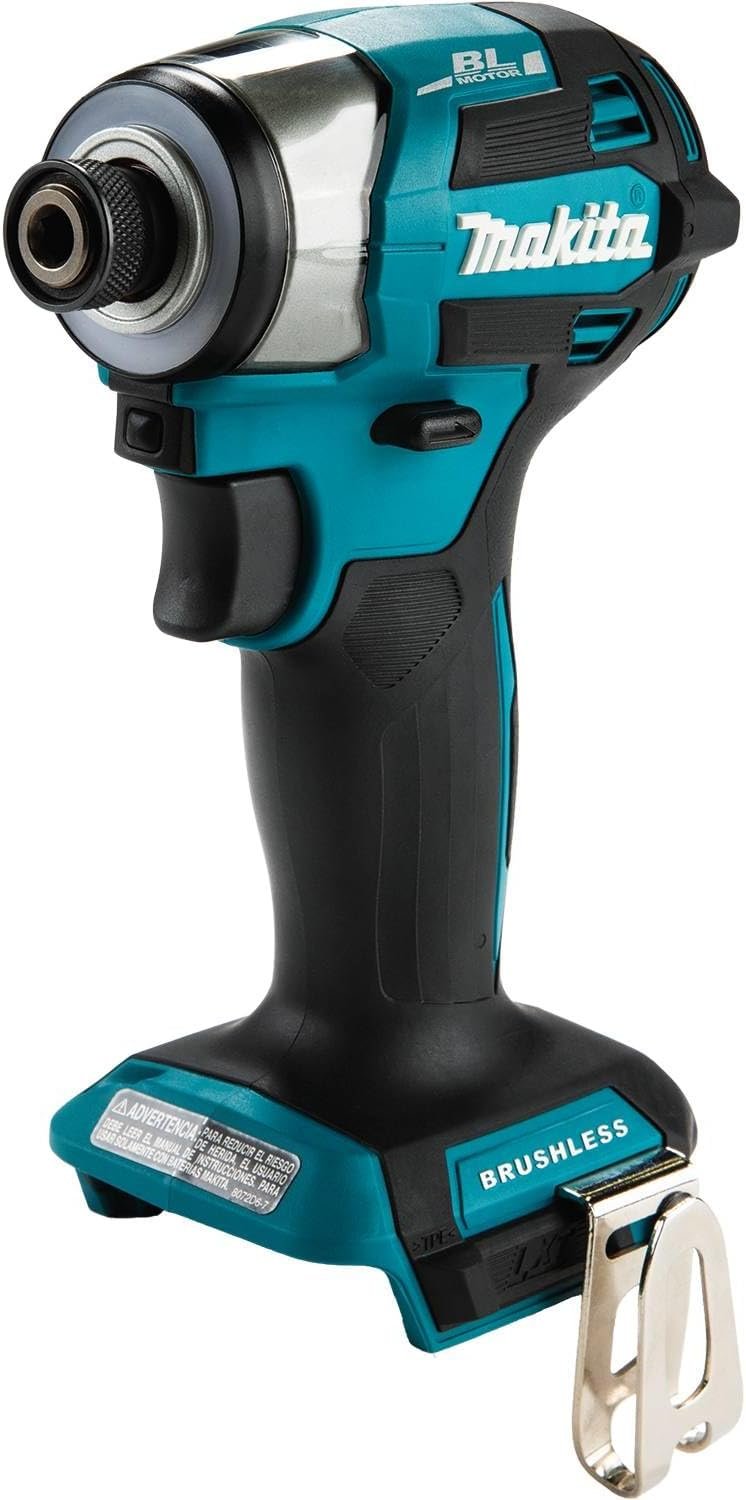
Makita XDT20Z 18V LXT Impact Driver
As an Amazon Associate I earn from qualifying purchases.
A good impact driver should deliver plenty of fastening power without making every screw feel like a battle. The Makita XDT20Z 18V LXT Impact Driver approaches that balance with a brushless motor, four selectable speeds and several electronic control modes designed for demanding professional work.
It’s a compact cordless tool, measuring just 4½ inches from front to back, yet it delivers up to 1,590 in-lbs of maximum torque.
That combination makes it particularly interesting for tradespeople working in restricted spaces, installing fixings or carrying out repetitive fastening tasks throughout the day.
For anyone already using Makita’s 18V LXT battery system, the XDT20Z offers a capable addition without introducing another cordless platform.
Why it works for professional fastening
The strongest feature of the Makita XDT20Z is the control it offers over its available power.
Instead of providing a single aggressive operating speed, it includes four selectable settings.
These range from a maximum of 1,100 RPM in the lowest setting to 3,600 RPM at full speed.
That flexibility matters when moving between different materials and fasteners.
Driving substantial wood screws into structural timber requires a different approach from installing smaller screws into sheet metal or fixing brackets to supporting frameworks.
The lower settings provide greater control when starting a fastener, while the higher settings allow the tool to work more quickly when the job demands it.
Makita’s brushless motor is another important feature.
By eliminating conventional carbon brushes, the motor reduces internal friction and is designed to operate more efficiently.
Electronic control helps balance motor performance with the demands of the work.
For a professional using an impact driver regularly, that efficiency can contribute to useful battery runtime and dependable operation.
The XDT20Z also includes an all-metal gear housing, providing additional durability around the mechanism responsible for transmitting its fastening power.
It’s a thoughtful combination of compact construction and serious working capability.
What it feels like to use
The XDT20Z has the familiar appearance of Makita’s professional cordless tools.
The compact teal housing, rubberised grip and substantial metal gear section give it a purposeful appearance without unnecessary decoration.
At just 4½ inches long, the short head is particularly valuable when working inside cupboards, between timber members or around building services.
Makita lists the tool at approximately 3.3 pounds with a compatible battery fitted.
That isn’t exceptionally heavy for a professional impact driver, although the choice of battery will influence its balance and handling.
A compact battery keeps the overall arrangement manageable, while a larger-capacity battery adds weight beneath the grip.
The rubberised handle provides a secure gripping surface, particularly when moving between different fastening positions.
A one-touch speed selector on the rear of the tool allows changes without navigating complicated menus.
Makita also provides an additional speed-selection control below the chuck.
This is useful when working in restricted spaces where one control may be easier to reach than the other.
Once a screw starts resisting rotation, the impact mechanism delivers its characteristic rapid hammering action.
Unlike a conventional drill, which can transmit substantial twisting force through the handle, an impact driver uses repeated rotational impacts to turn demanding fasteners.
That makes it useful for repetitive screwdriving, although the impact action introduces its own vibration and noise.
Quick-Shift and electronic control modes
The XDT20Z offers more than four conventional speed settings.
Its Quick-Shift Mode uses electronic control to help balance speed and torque during fastening.
The system is intended to reduce rotational speed and impact force as a screw approaches its final position.
This can help reduce the likelihood of damaged screw heads, stripped threads or overtightened fasteners.
Makita also includes Assist Mode, which begins driving at a lower speed until tightening starts.
This is particularly useful when positioning screws that might otherwise slip or become difficult to control during the initial stage.
Two Tightening Modes are designed for self-drilling screws in thin and thick metal.
These settings help the driver respond more appropriately to different fastening conditions.
The reverse rotation auto-stop function is another practical addition.
When loosening a fastener, the tool can stop rotation and impact once the screw has been loosened sufficiently.
This helps reduce the chance of a fastener dropping unexpectedly during removal.
None of these systems eliminates the need for careful trigger control, but they provide useful assistance when changing between different tasks.
For comparison, our DEWALT DCF860B High-Torque Impact Driver offers a different balance of three-speed control and particularly high fastening torque.
The Makita places considerable emphasis on its electronic assistance modes and compact handling.
Practical features that matter on site
Small details often determine how convenient a professional tool becomes during everyday use.
One of the XDT20Z’s most useful features is its built-in LED light ring.
Rather than relying on a single light positioned beneath the chuck, the ring provides illumination around the fastening area.
This helps reduce shadows when working inside cabinets, service cupboards and poorly illuminated spaces.
For plumbing and heating engineers, those are familiar working conditions.
Installing pipe-support brackets, fixing timber battens or securing equipment mounting frames often involves reaching into areas where natural light is limited.
The XDT20Z also features a one-touch quarter-inch hex chuck for quick accessory changes.
This makes moving between compatible impact-rated screwdriver bits straightforward.
Makita has designed the chuck with dual ball bearings to help reduce bit wobble and runout.
Another practical feature is Extreme Protection Technology, which is intended to improve resistance to dust and water exposure in demanding working environments.
That doesn’t make the impact driver waterproof, but it provides useful additional protection against typical site conditions.
The tool also includes Makita’s Star Protection system when used with compatible batteries.
This allows the tool and battery to exchange information to help protect against overheating, overloading and excessive discharge.
For anyone maintaining a professional collection of cordless equipment, battery-system compatibility remains an important consideration.
Our Makita XAG09Z Brushless Angle Grinder guide covers another professional tool using Makita’s established 18V LXT platform.
Where an impact driver earns its place
An impact driver isn’t intended to replace every drill or screwdriver in a professional toolkit.
Its strength lies in fastening applications where speed, repeated work and controlled delivery of torque are important.
Timber construction is an obvious example.
Driving long screws into substantial timber can place considerable demands on an ordinary drill/driver.
The impact mechanism helps maintain rotational movement as resistance increases.
Installing mounting brackets, assembling structural frameworks and fixing timber supports are other suitable applications.
For plumbing and heating work, an impact driver can be useful when assembling support systems, securing brackets and installing suitable mechanical fixings.
However, the tool should never be used indiscriminately on plumbing connections, gas fittings or equipment requiring carefully controlled tightening torque.
For cutting and trimming tasks alongside fastening work, our DEWALT DCS356B Oscillating Multi-Tool guide explores another practical cordless option for installation and renovation work.
The important point is choosing the correct tool for each operation.
An impact driver is exceptionally useful for the right fastening task, but it isn’t a substitute for careful workmanship.
The drawbacks
Despite its professional construction and sophisticated electronic controls, the Makita XDT20Z has several limitations that should be understood before purchasing.
The first is that it is supplied as a bare tool.
The XDT20Z package does not include a battery or charger.
For tradespeople already using Makita’s 18V LXT system, that may be perfectly acceptable.
However, someone purchasing their first Makita cordless tool will need compatible batteries and a suitable charger before the impact driver can be used.
It is also important to check battery compatibility rather than assuming every Makita-branded battery will fit.
The XDT20Z is designed for the 18V LXT platform, not Makita’s separate 12V CXT or 40V XGT systems.
Makita recommends genuine compatible batteries and chargers.
The four-speed system and additional electronic modes take some familiarisation.
Having more control is generally beneficial, but it introduces decisions that aren’t necessary with a simpler impact driver.
Users need to understand which setting is appropriate for the fastener and material.
A high-speed setting that works effectively with a substantial timber screw may be far too aggressive for a small fixing.
The automatic assistance modes reduce certain risks, but they cannot guarantee that every screw will be driven correctly.
Inexperienced users may initially find themselves changing settings frequently while becoming familiar with the tool.
Its maximum torque is not suitable for every fastening job.
At 1,590 in-lbs, the XDT20Z produces substantial rotational force.
That is useful for demanding screwdriving, but it can easily damage smaller fasteners or delicate materials if the operator is careless.
Screw heads may become stripped, threads can be damaged and fasteners can be driven deeper than intended.
The tool has no conventional adjustable torque clutch comparable to that found on many drill/drivers.
Electronic modes offer useful control, but they don’t replace an appropriate torque-limiting tool when a precise tightening value is required.
This is particularly important with electrical terminals, mechanical assemblies and equipment manufacturers’ specified torque settings.
The Makita should not be used as a general replacement for a torque screwdriver or calibrated torque wrench.
It isn’t a conventional drill.
The quarter-inch hex chuck is designed primarily for compatible hex-shank accessories.
Although certain drilling accessories can be used with impact drivers, the XDT20Z does not provide the versatility of a conventional three-jaw drill chuck.
For drilling accurate holes in metal, timber or masonry, a dedicated drill remains the more appropriate choice.
The impact action can also be unsuitable for delicate drill bits or precision drilling operations.
Anyone looking for one cordless tool to perform every drilling and fastening task may find the impact driver too specialised.
Impact noise is another genuine drawback.
Under load, the internal hammer-and-anvil mechanism produces sharp, repetitive impacts.
That sound is noticeably different from the smoother operation of an ordinary drill/driver.
When working inside cupboards, small workshops or enclosed plant rooms, the noise can become particularly intrusive.
For prolonged impact work, suitable hearing protection is sensible.
This is worth considering for tradespeople who spend much of their working day inside occupied buildings.
A tool that is convenient for the operator can still be disruptive to people nearby.
Vibration remains a consideration.
Although an impact driver reduces some of the twisting reaction associated with conventional drills, it still generates vibration through the handle.
Repeated impact fastening over extended periods can become tiring.
The rubberised grip helps with handling, but it doesn’t eliminate the physical effects of prolonged use.
Operators should take appropriate breaks and follow sensible workplace vibration-control practices.
Battery weight affects the balance.
The short body gives the XDT20Z a compact appearance, but its working weight depends partly on the battery fitted.
A larger battery may provide longer runtime, although it also increases the overall mass.
This becomes particularly noticeable during overhead fastening or when the tool must be held at arm’s length.
For repetitive lightweight work, a smaller compatible battery may provide a more comfortable arrangement.
For heavy fastening over longer periods, greater battery capacity may be more useful.
There is no single battery configuration that will feel ideal for every task.
Battery runtime also depends heavily on workload.
Brushless motor efficiency is helpful, but demanding fastening still consumes considerable energy.
Driving substantial structural screws repeatedly will place more strain on a battery than installing small fixings.
Professional users should not assume that an advertised improvement in motor efficiency guarantees a particular number of fasteners per charge.
Actual runtime depends on battery capacity, material resistance, fastener dimensions and working conditions.
Having charged spare batteries available remains sensible for longer jobs.
Quality impact-rated accessories are essential.
An impact driver places repeated shock loads on screwdriver bits, adapters and other accessories.
Ordinary screwdriver bits may wear rapidly or fracture when exposed to demanding impact work.
Using suitable impact-rated accessories helps reduce this risk.
Worn bits should be replaced promptly rather than continuing until they damage screw heads or become difficult to remove.
The convenience of a quick-change chuck is only useful when the accessories themselves are appropriate for the job.
The compact design doesn’t suit every user’s hands.
The XDT20Z is designed to fit into restricted areas, but compact controls can feel less comfortable for users wearing thick gloves.
The position of the speed selectors may also require some adjustment to established working habits.
Someone accustomed to a simple trigger-and-direction-switch impact driver may find the additional controls unnecessary.
Ergonomics remain personal, even with well-designed professional tools.
Dust and water resistance have limits.
Makita’s Extreme Protection Technology improves resistance to harsh working conditions, but it doesn’t make the tool suitable for immersion or prolonged exposure to heavy rain.
The tool should still be protected from unnecessary moisture, cleaned appropriately and stored in a dry location.
Similarly, the electronic protection systems are not a reason to deliberately overload the driver.
They provide additional safeguards, not permission to exceed normal operating limits.
The 18V LXT platform is another long-term consideration.
For existing Makita users, battery compatibility is one of the tool’s strongest advantages.
For someone already committed to a different professional cordless system, the decision is less straightforward.
Adding another battery platform means maintaining separate batteries, chargers and potentially different storage arrangements.
It may be more sensible to consider a comparable impact driver within an existing system rather than accumulating several incompatible cordless platforms.
Finally, the XDT20Z may offer more capability than occasional users require.
Four speeds, electronic assistance modes, reverse auto-stop and sophisticated motor control are valuable features when fastening forms a regular part of the working day.
For someone assembling occasional furniture or driving a handful of household screws, much of that capability may remain unused.
The XDT20Z makes most sense when its professional features have a genuine job to perform.
Who it suits best
The Makita XDT20Z is particularly suitable for tradespeople who regularly drive screws and mechanical fixings.
Carpenters, electricians, plumbers, heating engineers and general installation professionals can all benefit from a compact impact driver when working on appropriate fastening tasks.
Its short body and LED lighting make it especially interesting for work inside service spaces, cupboards and restricted areas.
The electronic assistance modes should appeal to users who frequently change between timber screws and suitable self-drilling metal fixings.
It is also a logical choice for professionals who already own compatible Makita 18V LXT batteries.
However, users needing a conventional drill, precise tightening torque or a simple occasional-use screwdriver should consider whether a different tool would suit their work better.
For more professional drills, drivers, saws and specialist equipment, explore our Power Tools guides.
Is it worth the toolbox space?
The Makita XDT20Z combines the compact design of a modern impact driver with the control features expected from a serious professional tool.
Its brushless motor, four selectable speeds, Quick-Shift technology and dedicated fastening modes provide useful flexibility across demanding applications.
The LED light ring, compact head and compatible 18V LXT battery system add practical convenience.
The drawbacks are equally important. Batteries and a charger are sold separately, the electronic modes require familiarisation, and the impact mechanism is unsuitable for certain delicate or precisely controlled fastening operations.
Nevertheless, for tradespeople who regularly work with timber, brackets, framework and mechanical fixings, the XDT20Z offers a convincing combination of fastening performance and control.
It is a specialised tool rather than a universal solution, but in the right professional toolkit, that specialisation is precisely what makes it useful.
As an Amazon Associate I earn from qualifying purchases.