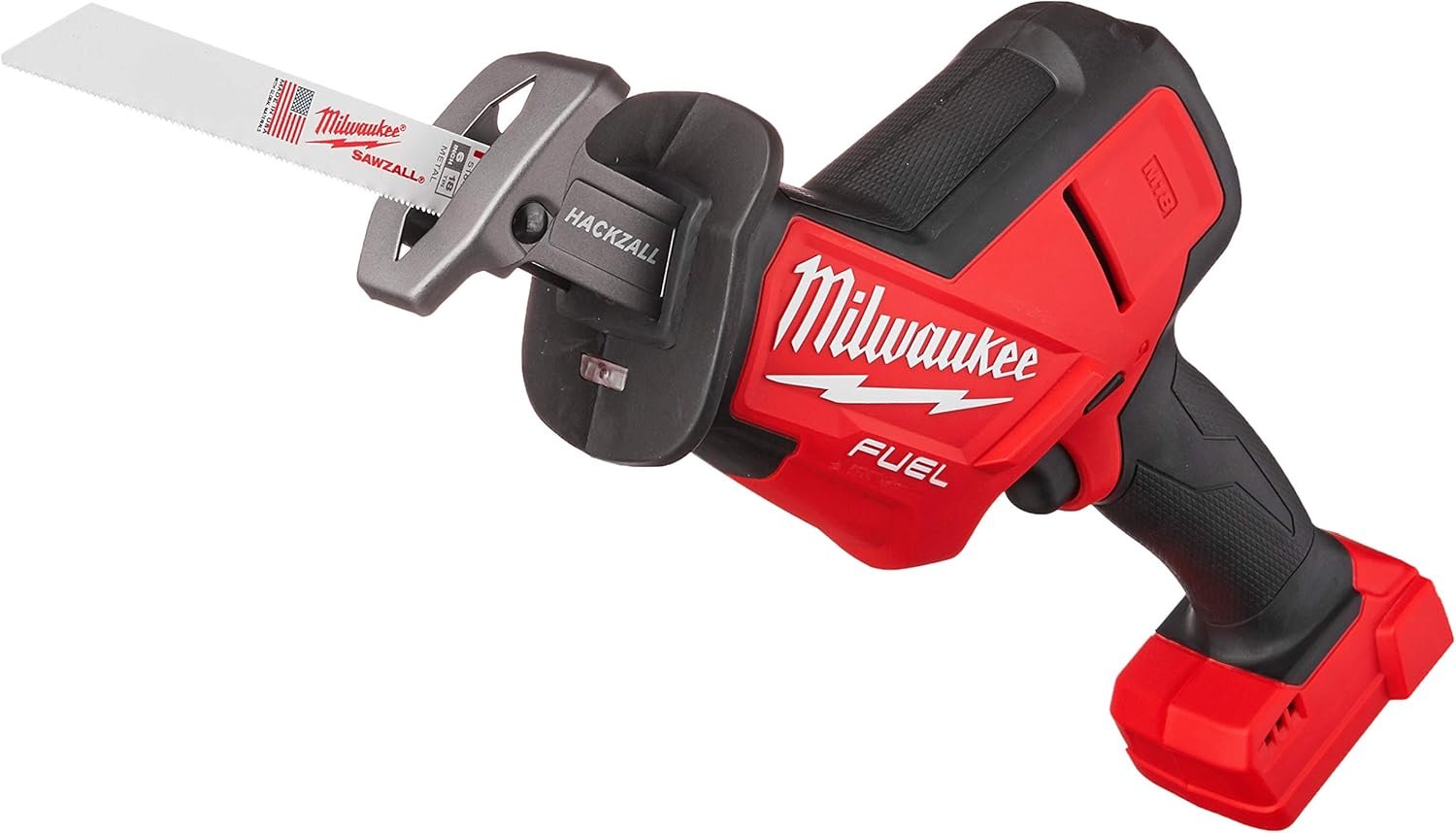
Milwaukee 2719-20 M18 FUEL Hackzall
As an Amazon Associate I earn from qualifying purchases.
The Milwaukee 2719-20 M18 FUEL Hackzall is a compact cordless reciprocating saw built for cutting jobs where a full-size reciprocating saw can feel unnecessarily long, heavy or awkward.
For plumbers, heating engineers, electricians, maintenance trades and general contractors, that shorter one-handed layout can be particularly useful when working between joists, beneath sinks, inside cupboards or around existing services.
This is not simply a small DIY saw wearing Milwaukee colours. It sits in the M18 FUEL range, using a POWERSTATE brushless motor and Milwaukee’s REDLINK PLUS electronics, with a 7/8-inch stroke and variable speed up to 3,000 strokes per minute.
It is also worth being clear from the beginning that the 2719-20 is sold as a bare tool. The battery and charger are not included.
Why it works as a trade cutting tool
The Hackzall format is really about access and control.
A traditional reciprocating saw normally places both hands some distance apart along a long body. That works extremely well for demolition and aggressive cutting, but it can become cumbersome when the pipe or timber you need to cut is tucked into a tight corner.
The 2719-20 brings the grip, trigger and blade much closer together. That shorter layout allows the saw to be held and guided in spaces where the rear of a full-size machine might foul a wall, floor, cabinet or another service.
For plumbing work, that can be useful when cutting copper, plastic pipe, threaded rod, timber around pipework or old fixings during alterations.
Electricians and maintenance engineers can find the same advantage when cutting conduit, strut, timber and other materials in restricted areas.
The important point is not simply that the Hackzall is smaller. It is that its shape can let you position the blade where a conventional reciprocating saw would be awkward.
What it feels like to use
The 2719-20 has the familiar solid feel of Milwaukee’s M18 professional tools.
The main grip is thick enough to hold securely, with rubberised areas where the hand naturally wraps around the body. Because the motor and blade sit in line with the hand, the tool feels more compact than a conventional Sawzall-style machine.
Battery choice changes that balance noticeably.
A compact M18 battery keeps the rear of the tool relatively tidy and suits overhead or tight-access work. A larger battery gives more runtime but adds weight and bulk behind the hand.
That is one reason this type of saw works particularly well for tradespeople already using the M18 battery platform. You can choose the battery size to suit the job rather than carrying one fixed setup everywhere.
The variable-speed trigger is another useful feature. Light pressure gives a slower blade speed for starting a cut accurately, while squeezing further increases the speed as the blade settles into the material.
That control matters when cutting metal pipe or working close to a finished surface, where immediately attacking the job at full speed can make the blade wander or chatter.
7/8-inch stroke and 3,000 SPM
Milwaukee gives the Hackzall a 7/8-inch stroke length with a no-load speed range of 0–3,000 strokes per minute.
A longer stroke moves more blade through the material on every cycle, while stroke speed determines how frequently that movement happens.
The 7/8-inch stroke is a sensible compromise for a compact one-handed saw. It is long enough to remove material efficiently, but the tool remains noticeably shorter and easier to manoeuvre than many full-size reciprocating saws.
For pipe cutting, timber alterations and general trade work, that balance between cutting speed and compactness is more useful than chasing the largest possible stroke figure.
Quik-Lok blade changes
Milwaukee uses its Quik-Lok blade clamp.
It accepts standard reciprocating-saw blades, so you are not tied to an unusual proprietary blade format.
That matters on site. Reciprocating blades are consumables. Metal blades dull, timber blades lose teeth and blades sometimes get bent when working in awkward positions.
The clamp is operated without a separate key or Allen wrench, making blade changes quicker when moving between materials.
The blade can also be fitted in different orientations depending on the cut and access available. That small detail can make a considerable difference when working near floors, ceilings or underneath an installation.
The pivoting shoe
The shoe at the front of the saw pivots against the workpiece.
Keeping the shoe firmly in contact with the material helps stabilise the saw and reduces the tendency for the blade and tool body to bounce around.
Anyone who has used a reciprocating saw with the shoe floating away from the material will know how quickly vibration increases.
The shoe is therefore not simply something that protects the front of the tool. It is part of using a reciprocating saw properly.
Brace it against the work where possible and the cut generally starts more cleanly, feels more controlled and puts less unnecessary movement into the tool.
Useful for pipework
For plumbing and heating work, the Hackzall format makes particular sense.
Cutting out old copper, plastic waste pipe, threaded rod, brackets or redundant pipework often involves awkward access rather than particularly large material.
A full-size reciprocating saw will certainly cut those materials, but fitting it into the working space can be the harder part.
With the correct blade fitted, the 2719-20 gives you a much shorter tool to position around existing services.
That can be particularly useful during alterations where walls, cabinets, joists and pipework all have to remain largely undisturbed.
Blade choice is critical, though. A coarse timber blade and a fine metal-cutting blade behave very differently.
Matching the blade to the material usually makes more difference than simply forcing the saw harder against the job.
Useful around timber and general construction
The same compact layout works well for timber alterations.
Nail-embedded timber, battens, framing and small sections that need cutting in place are natural reciprocating-saw jobs.
The Hackzall can also be useful where there is not enough clearance to swing a hand saw comfortably.
This is not a precision finishing saw.
If you need a perfectly straight visible cut on new joinery, a circular saw, jigsaw or hand saw may be the better tool.
The Hackzall is more at home when access and speed matter more than a furniture-quality edge.
Brushless motor and electronics
The POWERSTATE brushless motor removes the carbon brushes used in a conventional brushed motor.
Milwaukee’s REDLINK PLUS electronics monitor the tool, battery and motor and provide protection against conditions such as overload and overheating.
For a professional tool that may spend its life cutting metal, timber and demolition material, those electronics have a practical purpose.
Reciprocating saws are demanding tools. The blade can bind suddenly, a cut can tighten around the blade and users naturally tend to push harder when progress slows.
Electronic protection cannot replace good technique, but it adds another layer of protection during demanding work.
Lower vibration matters
Reciprocating-saw vibration is tiring.
The blade repeatedly changes direction thousands of times each minute, and some of that movement inevitably reaches the user.
Milwaukee uses a counterbalance system in the 2719-20 to help reduce vibration through the tool.
That is particularly useful with a one-handed design.
Less shaking makes it easier to begin a cut accurately and can make the saw feel less tiring during repeated cuts.
It does not remove vibration entirely. A blunt blade, incorrect blade choice or a shoe that is not held against the work can still make any reciprocating saw feel rough.
Good technique remains important.
The drawbacks
The first drawback is straightforward: the 2719-20 is a bare tool.
There is no M18 battery and no charger included with this version.
For someone who already owns Milwaukee M18 tools, that may be ideal. You are not paying for another charger or duplicating batteries already in the van.
For somebody entering the M18 system for the first time, however, the real setup requires more than the saw itself. A compatible battery and charger are essential before the tool can do anything.
Battery choice also affects the balance.
A large-capacity M18 pack adds considerable bulk behind the hand. That increases runtime, but it partially works against one of the Hackzall’s biggest advantages: compact handling.
A smaller pack makes the saw neater and more agile, especially overhead or in confined spaces, but naturally gives less working time between charges.
There is no perfect battery choice for every job.
The second compromise is that this is still a reciprocating saw.
It cuts quickly, but it is not a precision saw.
Even with a steady hand and a good blade, the long flexible blade can wander. For work where the finished edge remains visible, another tool may produce a cleaner result.
The Hackzall is at its best for installation, alteration, rough cutting and removal work rather than fine joinery.
The short one-handed layout also does not make it a universal replacement for a full-size Sawzall.
When cutting large timber, thick demolition material or carrying out sustained heavy work, a larger two-handed reciprocating saw provides more leverage and a different working stance.
The Hackzall wins when space and control are the problem. A full-size reciprocating saw can still be preferable when the material itself is the problem.
The 7/8-inch stroke is another example of that compromise.
It suits the compact format well, but larger professional reciprocating saws may use longer strokes to move more blade through heavy material with each cycle.
For ordinary pipe, smaller timber and general trade material, the Hackzall has plenty of purpose. For hours of aggressive structural demolition, it would not be my first choice.
Blade choice can make or break the experience too.
A worn metal blade can make the saw feel underpowered. A blade that is too coarse can catch violently in thin material. A blade that is too short can also become unsafe because it needs to remain beyond the workpiece throughout the stroke.
That means keeping a sensible selection of blades is part of owning the tool.
The blade-clamp area also lives exactly where dust, metal filings and debris collect, so keeping it clean matters.
Hot blades are another practical nuisance. After cutting metal, the blade can become extremely hot. A quick-change clamp does not make a hot blade safe to grab immediately after the cut.
The compact format can also tempt users into casual one-handed cutting simply because the saw is capable of it.
That does not mean the workpiece should be held in the other hand.
A reciprocating blade can snag abruptly, particularly in thin pipe or loose material, and the reaction can be sharp.
Blind cuts deserve particular caution.
A Hackzall is exactly the sort of tool people reach for when opening walls, cutting floors or removing hidden material. Unfortunately, those are also the places where electrical cables, water pipes and gas lines may be concealed.
For someone with trade experience, that sounds obvious, but it remains one of the most important practical limitations of this type of saw.
Noise and vibration are unavoidable as well.
The counterbalance helps, but it does not transform reciprocating sawing into a quiet or vibration-free process. Long periods of cutting remain physically tiring.
Finally, the M18 platform itself can be either an advantage or a commitment.
If your van is already full of Milwaukee batteries, the 2719-20 slots neatly into what you own.
If your batteries are all DeWalt, Makita or another professional system, changing platform for one reciprocating saw is harder to justify.
The tool may be excellent, but battery-platform loyalty is a practical consideration, not something to ignore.
Who it suits best
The Milwaukee 2719-20 M18 FUEL Hackzall makes most sense for tradespeople who regularly need a reciprocating saw but frequently work in confined areas.
Plumbers and heating engineers are obvious users because pipework rarely presents itself in an open workshop with perfect access.
Electricians, maintenance engineers, installers and general contractors can benefit for much the same reason.
It is particularly logical for somebody already using Milwaukee M18 batteries.
In that situation, adding the bare tool gives you a compact reciprocating saw without duplicating chargers and battery packs.
Someone mainly carrying out heavy structural demolition may be better served by a full-size two-handed reciprocating saw.
And someone who needs clean, precise finished cuts should be looking at a different type of saw entirely.
Is it worth the tool bag space?
For the right trade, yes.
The Milwaukee 2719-20 M18 FUEL Hackzall earns its place through access rather than brute size.
Its 7/8-inch stroke, 0–3,000 SPM variable speed, brushless motor, pivoting shoe and Quik-Lok blade system give it the performance and convenience expected from a professional reciprocating saw.
The one-handed body is the feature that changes how it can be used.
When a pipe, bracket or timber is buried inside an installation and there simply is not room for a long full-size saw, the shorter Hackzall format can make an awkward cut much easier to approach.
It has limitations.
It is sold without a battery or charger, it does not replace a full-size demolition saw for every job, and blade choice and work holding have a major influence on how well it performs.
But for a tradesperson already invested in M18 who wants a compact cutting tool for tight-access work, the 2719-20 is a practical addition rather than another tool bought simply to fill a box.
For more professional cordless tools and workshop equipment, explore our Power Tools guides.
As an Amazon Associate I earn from qualifying purchases.