Milescraft 1318 DrillMate
As an Amazon Associate I earn from qualifying purchases.
Milescraft 1318 DrillMate
Drilling a perfectly straight hole with a handheld drill sounds simple until you’re halfway through a piece of timber and realise the bit has wandered off at an angle.
For woodworkers, furniture makers and DIY enthusiasts, those small inaccuracies can become surprisingly frustrating. A hole drilled slightly out of square can cause problems when fitting hardware, joining timber or assembling a project where everything needs to line up.
The Milescraft 1318 DrillMate offers a practical way to improve drilling control without needing a full-size drill press.
This portable drill guide works with a compatible handheld drill, using a sliding mechanism and adjustable base to help maintain a consistent drilling angle.
It’s a useful idea for anyone who wants more accuracy from the tools they already own.
Bring Drill-Press Guidance to Your Workbench
The main attraction of the Milescraft DrillMate is its guided drilling mechanism.
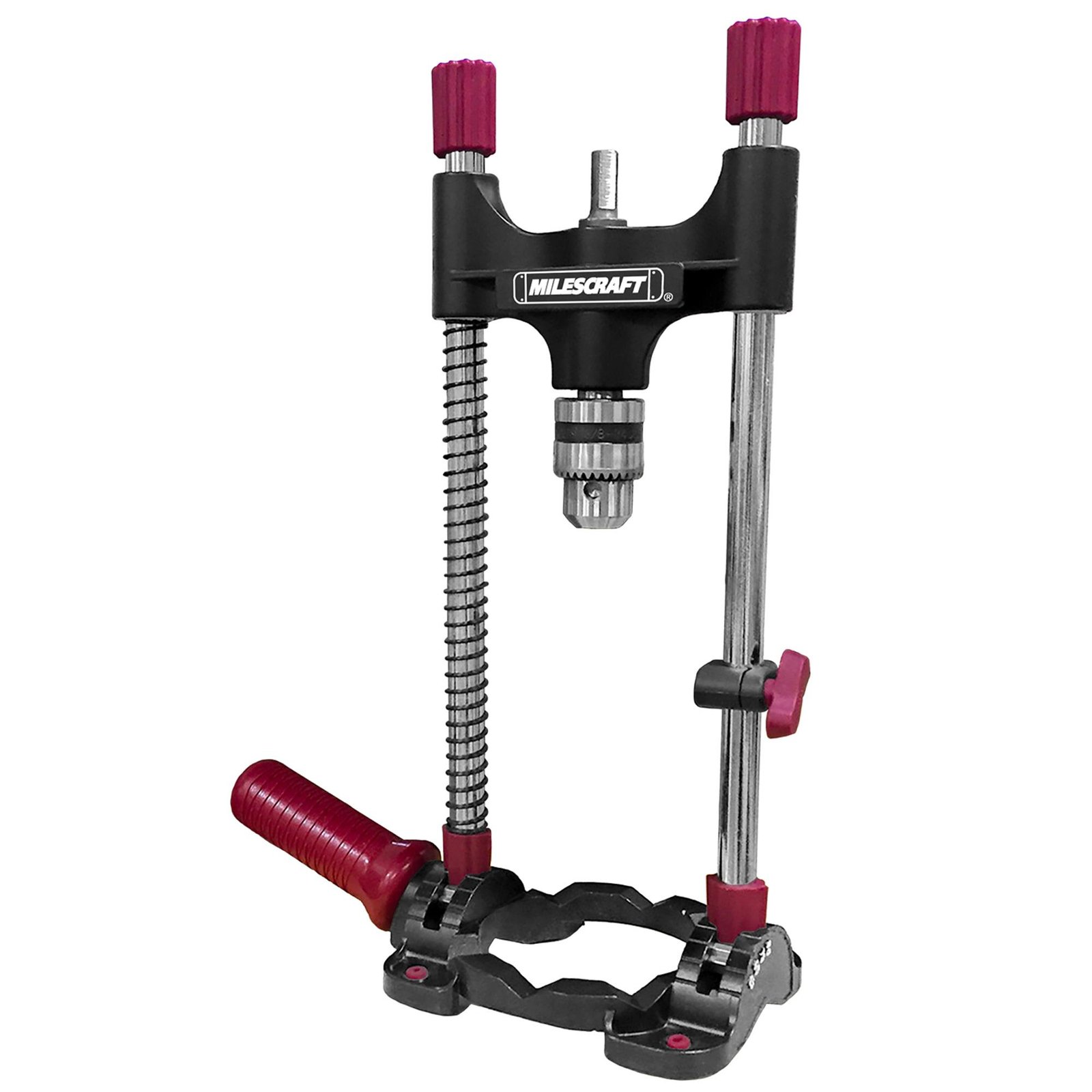
Rather than relying entirely on your hands to keep a drill straight, the DrillMate uses two steel guide rods and a sliding metal head to control the drilling movement.
The drill connects to the guide through a spindle, while a separate 3/8-inch keyed chuck holds the drill bit.
This arrangement helps keep the drilling path consistent as the head travels along the guide rods.
Milescraft uses a solid aluminium head with bushings and ball bearings designed to make the drilling movement smooth.
The result is a portable accessory that provides some of the guidance associated with a drill press without requiring a large stationary machine.
For someone building shelves, repairing furniture or working on smaller woodworking projects, that extra control can be valuable.
Of course, the drill itself remains important. A suitable drill with dependable speed control makes the combination more practical.
Our DEWALT DCF860B High-Torque Impact Driver article explores a different tool designed for fastening rather than precision guided drilling, helping explain why different jobs call for different equipment.
Straight Holes Without a Full-Size Drill Press
One of the most useful applications for the DrillMate is drilling at 90 degrees.
Keeping a handheld drill perfectly perpendicular to a workpiece is not always easy, particularly when working on narrow timber or awkwardly positioned materials.
The DrillMate’s guide rods provide a more controlled path for the bit.
This can be particularly helpful when drilling holes for furniture fittings, fixing positions and workshop projects where alignment matters.
The base also includes a central opening that provides clearance for the drill bit.
With the guide properly positioned, the operator can concentrate on feeding the drill steadily rather than constantly correcting its angle.
It is important to understand that the DrillMate doesn’t automatically position the hole for you. Measuring, marking and securing the workpiece remain essential.
Nevertheless, having a guided drilling movement can remove one of the more frustrating parts of accurate freehand drilling.
Adjustable Angles for More Versatile Projects
The DrillMate is not limited to straight vertical holes.
Milescraft provides adjustable drilling positions at 45, 60, 75 and 90 degrees.
These preset angles make the tool useful for projects requiring more than simple perpendicular drilling.
Angled holes can be required for decorative woodworking, certain joints, furniture construction and specialised fixing arrangements.
With the DrillMate, the head and guide assembly can be positioned at the required angle relative to the base.
This offers a level of flexibility that a basic fixed-angle drill guide cannot provide.
For occasional woodworking projects, the ability to adjust the drilling angle without investing in several separate jigs is particularly appealing.
The important part is securing the selected angle correctly before drilling.
A portable guide can help establish a drilling direction, but the accuracy of the finished hole still depends on careful setup and controlled operation.
A V-Groove Base for Round Materials
Drilling into a flat board is one thing. Working with round material introduces another challenge.
A drill bit can slip sideways on a curved surface before it begins cutting.
The Milescraft DrillMate has V-shaped grooves in its base that help position the guide against suitable cylindrical materials.
This can be useful when working with wooden dowels, rounded timber and certain other compatible workpieces.
The grooves help centre the guide over the curved surface, making positioning more straightforward than balancing a conventional drill against it.
The base also includes non-slip rubber feet intended to protect the workpiece and improve stability.
For more secure arrangements, Milescraft allows the feet to be removed so the base can be fastened to a suitable work surface.
That flexibility makes the DrillMate useful beyond one particular style of woodworking.
As with any drilling operation, round material must be secured against movement. The V-grooves help with positioning, but they do not replace proper clamping.
Repeat Holes More Consistently with the Depth Stop
When building a project that requires several holes of similar depth, consistency matters.
A hole that is too shallow may prevent a fixing from seating correctly. One that is too deep can damage the material or emerge through the opposite face.
The Milescraft DrillMate includes an adjustable stop collar designed to control drilling depth.
Once the correct depth has been established, the stop can be positioned to limit further travel.
This is useful for repeated holes in furniture components, timber blocks and other workshop projects.
It can also reduce the need to estimate depth visually during every drilling operation.
For anyone producing several similar components, the depth stop adds a useful degree of repeatability.
However, it is still important to measure carefully and test the setup on spare material before working on a finished piece.
Built for Portable Workshop Use
The Milescraft 1318 DrillMate combines steel guide rods with a cast aluminium base and head.
According to the manufacturer’s specifications, it weighs approximately 3.26 pounds, or 1.48kg.
That gives it more substance than a simple plastic drilling template while remaining portable enough to move around a workshop.
The metal construction also provides a relatively rigid foundation for the guide mechanism.
For users with limited workshop space, portability is one of the biggest attractions.
A full-size drill press requires a dedicated location and is not always practical for occasional DIY work.
The DrillMate can be brought to a workbench, used for a particular task and stored away afterwards.
It can also be useful when working with larger pieces of timber that would be awkward to position beneath a stationary drill press.
For cutting and adjustment jobs in similarly awkward spaces, our DEWALT DCS356B Oscillating Multi-Tool article explores another compact workshop tool designed to improve access and control.
Making More of Your Existing Drill
Another appealing feature is that the DrillMate is designed to work with suitable handheld power drills.
That means someone who already owns a compatible drill may not need to purchase another powered machine simply to gain access to guided drilling.
The DrillMate includes a spindle with a 5/16-inch hex shank that connects to the driving drill.
The separate keyed chuck accepts suitable drill bits up to 3/8 inch in diameter.
Once correctly assembled, the guide uses the drill’s motor to rotate the bit while the sliding mechanism directs its movement.
This makes the DrillMate an interesting middle ground between ordinary freehand drilling and a dedicated drill press.
It is not intended for use with impact drivers or hammer drills.
A conventional compatible drill operating in the appropriate drilling mode is the sensible choice.
Drawbacks: What You Should Know Before Buying
The Milescraft 1318 DrillMate has plenty of practical appeal, but it also has limitations that deserve attention.
Understanding those compromises is important because a portable drill guide is not the same thing as a professional drill press.
It Cannot Match the Rigidity of a Full-Size Drill Press
The biggest limitation is stability.
A stationary drill press normally has a substantial column, fixed worktable and rigid support structure.
The DrillMate relies on a portable base, twin guide rods and the operator’s ability to keep the setup correctly positioned.
Although the metal components provide useful support, the arrangement can still move if excessive sideways pressure is applied.
That means accuracy is not entirely automatic.
The guide can help keep the drill aligned, but the workpiece must be secure, the base must be stable and the drilling force needs to remain controlled.
For occasional woodworking and DIY projects, the DrillMate may provide enough guidance.
For repeated precision machining or demanding production work, a properly maintained drill press remains the stronger choice.
Careful Setup Is Essential
The DrillMate does not eliminate measuring, marking or positioning.
Before drilling, you must identify the correct hole location, select the required angle and ensure the guide is firmly supported.
The adjustable mechanism introduces several components that need to be correctly positioned and tightened.
If the selected drilling angle is not properly secured, the finished hole may not follow the intended direction.
This matters particularly when drilling angled holes.
A small positioning error at the start can become more noticeable as the drill bit enters deeper into the material.
For critical work, it is sensible to test the arrangement on scrap material before drilling the final component.
The DrillMate can improve control, but it cannot compensate for careless preparation.
The 3/8-Inch Chuck Limits Bit Selection
The supplied keyed chuck has a maximum nominal capacity of 3/8 inch.
That is suitable for many ordinary drilling jobs, but it cannot accommodate every drill bit.
Large shank sizes, oversized drilling accessories and certain specialist cutters may not fit.
The size of a cutter’s working diameter is not always the same as its shank diameter, so compatibility must be checked before use.
The DrillMate also has physical clearance limitations.
Long bits and unusually large accessories may interfere with the guide assembly or exceed the available drilling travel.
Anyone planning to use it for a specific specialist application should check the relevant dimensions before buying.
The Keyed Chuck Is Less Convenient Than Keyless Designs
Many modern cordless drills use keyless chucks that allow bits to be changed quickly by hand.
The DrillMate uses a traditional keyed chuck.
This can provide a secure grip when tightened correctly, but it makes bit changes a little slower.
You’ll need the chuck key whenever changing bits, and it is another small accessory to keep track of.
For a project involving repeated use of one bit size, this is unlikely to be a major inconvenience.
For someone switching between different drill bits every few minutes, the additional step may become irritating.
The keyed arrangement is functional rather than particularly quick.
It Doesn’t Include a Power Drill
The DrillMate is a guide attachment, not a complete powered drilling machine.
A suitable handheld drill is required.
For someone who already owns a compatible drill, this is part of the appeal.
But buyers without one must factor in the additional cost of the power tool, battery or power supply and suitable drill bits.
It is also important to check that the drill can securely accommodate the DrillMate’s drive shank.
Not every powered driver is appropriate.
Milescraft specifically states that the DrillMate is not intended for impact drivers or hammer drills.
Using an unsuitable tool could damage the guide or create unnecessary safety risks.
There Is a Learning Curve
Although the basic idea is straightforward, using a portable drilling guide takes practice.
You need to become familiar with the sliding head, guide rods, angle settings and depth stop.
The tool may also feel quite different from holding a drill directly against a workpiece.
Some people may initially find it awkward to coordinate downward pressure with keeping the base correctly positioned.
This is especially relevant when working on smaller or irregularly shaped materials.
Starting with simple 90-degree holes in securely clamped scrap timber is a sensible way to understand the mechanism.
Once the setup becomes familiar, the guide may feel more natural to operate.
But buyers should not expect perfect results without taking time to learn how it works.
Round Materials Still Need Proper Clamping
The V-groove base is a useful feature, but it should not create a false sense of security.
A rounded wooden dowel or metal tube can rotate or shift if it is not restrained properly.
The grooves help position the guide over curved stock, but they do not necessarily secure the workpiece against movement.
That means additional clamps or a suitable holding jig may be necessary.
This becomes particularly important when drilling into hard materials where the bit may grab or wander.
The safest arrangement is one where the material cannot roll, twist or lift during drilling.
The DrillMate improves positioning, but responsible workholding remains essential.
It Takes More Space Than a Simple Drill Guide Block
The DrillMate is portable, but it isn’t a tiny pocket-sized accessory.
Its metal base, twin guide rods and sliding head occupy considerably more room than a small fixed-angle drilling template.
It also has a noticeable weight of approximately 3.26 pounds.
That’s perfectly manageable for workshop use, but it is another item to accommodate in a toolbox or storage cupboard.
For someone who only needs the occasional straight hole, a simple drilling guide block may be sufficient.
The DrillMate becomes more attractive when its adjustable angles, depth stop and ability to work with varied stock are genuinely useful.
Heavy Drilling Demands Are Not Its Strongest Application
A portable drill guide should not be mistaken for a machine intended for aggressive industrial drilling.
Large cutters, heavy pressure and prolonged demanding work can place substantial forces on the guide mechanism.
The DrillMate is better understood as an accuracy aid for appropriate drilling tasks rather than a way to dramatically increase the power or capability of a handheld drill.
It does not make an underpowered drill stronger.
Nor does it remove the need to use suitable bits, appropriate drilling speeds and safe techniques for the material being worked.
Professional users regularly drilling difficult materials may be better served by a more rigid dedicated machine.
It Won’t Automatically Produce Perfect Holes
Perhaps the most important limitation is that the finished result still depends on the operator.
A blunt drill bit can wander.
Poor clamping can allow the material to move.
Incorrect feed pressure can produce a rough hole or damage the workpiece.
The DrillMate addresses the challenge of controlling drilling direction, but it cannot solve every problem associated with drilling.
Good-quality bits, accurate marking, proper workholding and sensible speed selection remain essential.
For someone prepared to use it carefully, the guide can be a useful addition to the workshop.
For someone expecting it to remove every element of skill and preparation, it may prove disappointing.
Who the Milescraft 1318 DrillMate Suits Best
The DrillMate is particularly suitable for DIY enthusiasts, hobby woodworkers and home workshop users who want greater control over their drilling.
It makes sense for projects involving furniture assembly, timber construction, repeated holes and occasional angled drilling.
People who already own a good handheld drill but don’t have space for a full-size drill press may find it especially appealing.
It could also be useful for tradespeople who occasionally need guided drilling away from a fixed workshop.
However, anyone undertaking demanding production work or requiring consistently tight machining tolerances should consider whether a dedicated drill press would be a better investment.
For more equipment ideas, our Power Tools guides cover drills, saws, grinders and other useful workshop machinery.
Final Verdict: A Practical Way to Improve Drilling Control
The Milescraft 1318 DrillMate offers an appealing compromise between ordinary freehand drilling and a stationary drill press.
Its steel guide rods, adjustable drilling angles, V-groove base and depth stop make it a versatile accessory for suitable woodworking and DIY projects.
The metal construction gives the mechanism a substantial foundation, while the portable design makes it practical for workshops where space is limited.
It does require careful setup and cannot match the rigidity of a dedicated drill press.
But for someone who wants straighter holes, more controlled angled drilling and greater consistency without investing in another large machine, the DrillMate is well worth considering.
It is a useful example of how the right accessory can make an existing power tool more versatile without making the workshop unnecessarily complicated.
As an Amazon Associate I earn from qualifying purchases.