DEWALT DXV10S-QT STEALTHSONIC Wet/Dry Vac
As an Amazon Associate I earn from qualifying purchases.
The DEWALT DXV10S-QT STEALTHSONIC Wet/Dry Vac is the sort of tool that can spend days sitting quietly in a workshop and then suddenly become one of the most useful pieces of equipment you own.
For plumbers and heating engineers in particular, that usefulness goes well beyond sweeping sawdust from a floor. Water is part of the job. Pipes get drained, radiators are removed, valves fail, cylinders are changed and occasionally something leaks despite every precaution.
When that happens, being able to collect water quickly can turn what might have become a major cleanup into a much more manageable job.
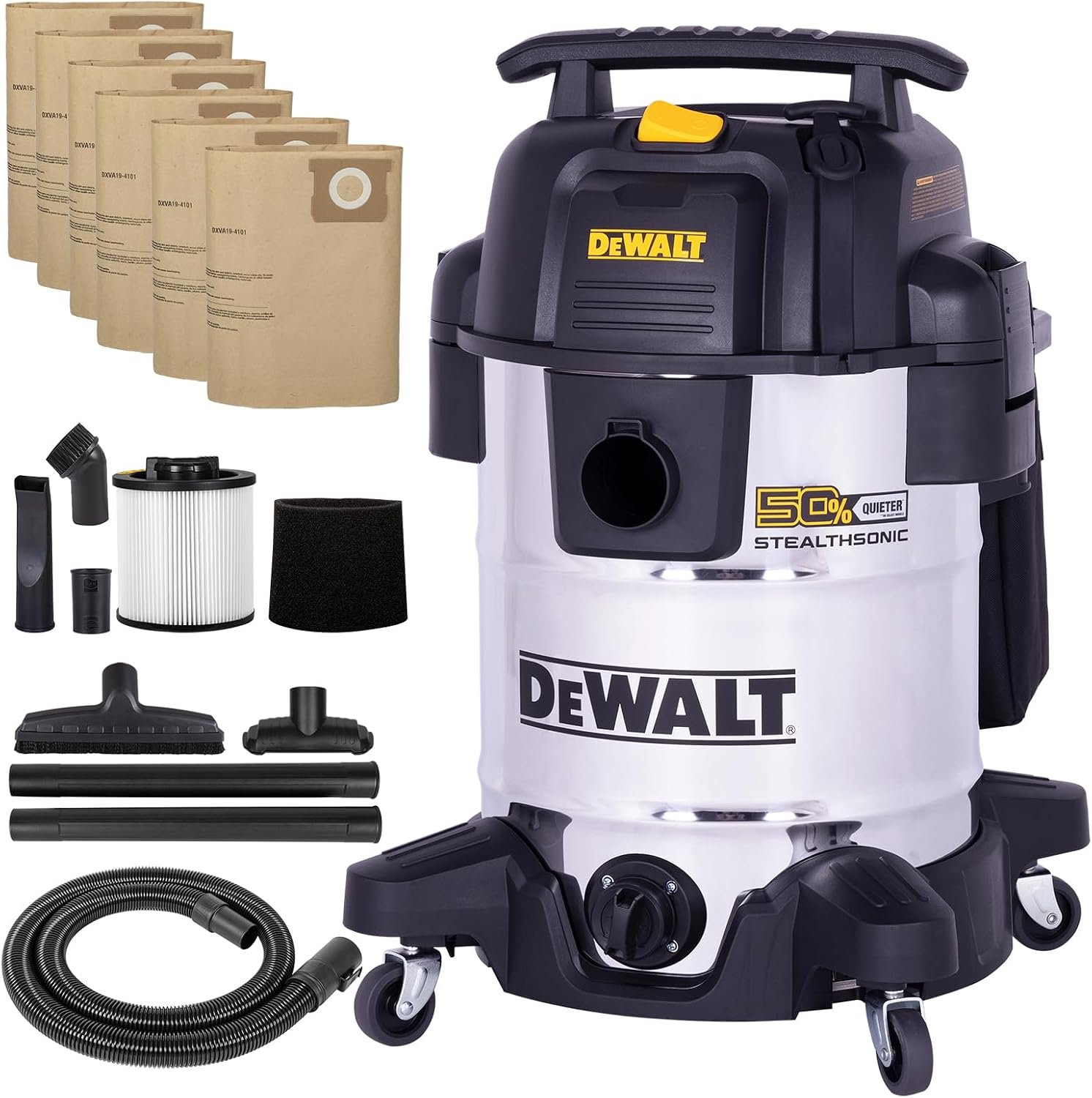
The DXV10S-QT combines a 10-gallon stainless-steel tank, 5 peak HP motor and wet-and-dry capability with DEWALT’s STEALTHSONIC quieter-running design. It is substantial enough for trade and workshop cleanup while remaining mobile on four casters.
Why it makes sense for plumbing and heating
A wet/dry vacuum is not a plumbing tool in the traditional sense.
It does not cut pipe, press fittings or diagnose a heating fault.
But it can make many plumbing jobs considerably easier.
Imagine removing an old radiator. You can drain it carefully, protect the floor and have containers ready, yet there is often still residual water inside the system.
The same applies when changing pumps, valves, cylinders or sections of pipework.
A few litres of dirty heating-system water on a carpet or finished floor can become a much bigger problem than the original repair.
A proper wet vac gives you another way of controlling that water.
It can collect spills from hard floors, remove standing water from an area around a leak and help clear up after draining work.
That is why I would regard one as a very practical addition to a plumber’s equipment rather than merely a workshop cleaner.
A useful 10-gallon capacity
The stainless-steel tank holds 10 gallons, giving the DXV10S-QT enough capacity for sizeable cleanup work without turning the machine into an enormous industrial unit.
That middle ground matters.
A very small wet vac can fill quickly when dealing with a genuine water leak.
At the other extreme, an enormous commercial vacuum may be awkward to carry through houses, around bathrooms or into smaller work areas.
Ten gallons gives you useful breathing room.
You still need to monitor how much liquid has been collected, but you are not stopping every few minutes to empty a tiny container.
The tank also includes a built-in drain port, so once a substantial amount of water has been collected, you do not necessarily have to lift and tip the entire machine to empty it.
For wet work, that feature is more valuable than it may initially appear.
Ten gallons of water weighs a lot.
Being able to position the vacuum somewhere suitable and release collected liquid through the drain can be considerably easier on your back than lifting a nearly full tank.
What it feels like to use
This is a corded machine rather than a lightweight cordless vacuum.
The DXV10S-QT weighs approximately 25.3 lb empty and measures around 21.4 x 16.9 x 26.6 inches.
It therefore feels like a proper workshop or jobsite appliance rather than something you carry around one-handed.
Four rubberised swivel casters allow the tank to roll behind you as you work, and the top handle provides somewhere substantial to grip when it needs lifting over a threshold or into a vehicle.
The stainless-steel drum gives the machine a more industrial appearance than a plastic-bodied shop vacuum.
Around the back is an accessory storage bag, so the nozzles do not all need to be thrown loose into the van or workshop after every job.
There is also a strap for keeping the hose under control during storage.
These are small details, but anyone who has used workshop vacuums regularly knows how quickly loose hoses and attachments become irritating if there is nowhere sensible to put them.
STEALTHSONIC quieter operation
One of the more interesting parts of this model is the STEALTHSONIC design.
The DXV10S-QT specifications quote an operating noise level of approximately 65 dB.
A wet/dry vacuum is never going to be silent.
There is still a substantial electric motor moving a large volume of air, and the sound of debris travelling through the hose can add noise of its own.
But quieter operation matters more than it might seem.
Traditional shop vacuums can produce a harsh motor noise that becomes tiring surprisingly quickly, particularly when they are running for extended periods.
On domestic plumbing jobs, lower noise can also make a difference when you are working inside somebody’s home rather than on an open building site.
It is easier to speak to someone nearby, less disruptive to the rest of the property and simply more pleasant when you are using the vacuum repeatedly throughout the day.
5 peak HP motor
The DXV10S-QT uses a motor rated at 5 peak horsepower.
Peak horsepower should not be confused with the continuous output figure of a conventional power tool motor, but it gives a useful indication of where the vacuum sits within the wet/dry-vac range.
This is intended for substantial wet and dry cleanup rather than being a small household dust extractor.
For workshop use, that means dealing with general debris, sawdust, dirt and material around the bench or floor.
For plumbing work, suction strength becomes particularly useful when drawing up standing water before it can spread further across a finished surface.
The 1-7/8-inch diameter, 7 ft hose gives a reasonable compromise between airflow and manoeuvrability.
It is large enough for workshop debris without becoming as cumbersome as some very large commercial hoses.
Wet pickup needs the correct filter setup
One important detail with any wet/dry vacuum is remembering that wet and dry operation do not use exactly the same filter arrangement.
For dry work, this DEWALT includes a washable cartridge filter and a disposable dust bag.
For collecting liquids, the supplied foam filter is used and the dry cartridge filter needs to be removed according to the operating guidance.
That is worth getting into the habit of checking before every wet job.
If the vacuum has spent the week collecting dry workshop dust, do not simply push the hose into a pool of water without first configuring it for wet pickup.
The changeover is straightforward, but it is still something the operator has to do.
After wet use, cleaning and drying the tank and equipment before putting everything away also helps prevent stale smells and keeps the vacuum ready for the next job.
More than a water vacuum
Plumbing might be the reason I particularly like this product for Zennh, but it has much wider workshop value.
The supplied accessories include:
- a 7 ft hose
- two extension wands
- washable cartridge filter
- disposable dust bag
- foam wet-use filter
- round brush
- floor brush
- utility nozzle
- car nozzle
- tool adaptor
- accessory storage bag.
That allows the same machine to move from water cleanup to workshop floors, vehicles, benches and general jobsite mess.
The extension tubes and floor attachment let you use it much more like a conventional upright cleaning tool when clearing a larger floor.
The smaller nozzles make more sense around corners, machinery, vehicles and tighter work areas.
And the tool adaptor provides another option for connecting suitable workshop equipment when dust extraction is required.
For someone with limited storage space, having one machine capable of handling both liquids and ordinary workshop debris is much easier to justify than having separate equipment for every cleaning job.
Useful reach around a job
The vacuum has a 10 ft power cord and 7 ft hose, giving around 17 ft of basic reach before the extension wands are taken into account.
That is useful when working in bathrooms, plant rooms or garages because the power outlet is rarely exactly where you want the vacuum to stand.
The corded design also means there is no battery-runtime calculation to make.
If there is mains power available, the vacuum keeps working.
For clearing a large amount of water, that can be reassuring.
A cordless wet vac is wonderfully convenient for quick jobs, but a sustained cleanup operation can consume batteries quickly.
With this machine, runtime is not the limiting factor.
The built-in drain matters more than it sounds
For a plumber, I think the drain port deserves particular attention.
Dry debris is relatively easy to empty. Remove the motor head and tip the tank into a suitable waste container.
Water is different.
A nearly full 10-gallon tank can become extremely heavy.
The drain port lets collected liquid be released near floor level rather than forcing you to pick up the entire stainless-steel container and pour it out from the top.
Of course, where that water is discharged matters.
Water containing heating-system sludge, chemicals or other contamination should be disposed of appropriately rather than simply emptied wherever convenient.
But mechanically, having that drain makes the machine much more practical for serious wet use.
The drawbacks
The first drawback is size.
A 10-gallon wet/dry vacuum is useful because it holds a substantial amount, but that also means it takes up a meaningful amount of space in the van, workshop or garage.
At around 26.6 inches high and 25.3 lb before anything is collected, this is not a machine you will tuck behind a toolbox.
If you only ever deal with tiny spills or need something that can live permanently under a bench, a smaller wet vac may be easier to store.
The weight increases dramatically when collecting water.
One US gallon of water weighs a little over eight pounds.
That means you should never look at a 10-gallon capacity and assume a completely full tank will still be easy to lift.
Fortunately, the drain port helps considerably, but only when you can move the vacuum to somewhere suitable for draining.
If you have filled it upstairs during a leak and need to transport the collected water elsewhere, the sheer weight becomes a practical issue.
The machine is also corded.
That gives unlimited runtime, but cords are not always convenient around wet plumbing jobs.
You need a safe electrical supply, and cables should always be kept away from standing water and positioned so that nobody trips over them.
In some awkward locations, a cordless vac may be easier to deploy quickly.
The 7 ft hose is reasonable but not exceptionally long.
There will be occasions when you need to move the entire vacuum closer rather than leaving it in one position and reaching the whole job from there.
Fortunately the casters make that easier, but rolling a large canister around a furnished room still requires some care.
Those casters also work best on reasonably smooth surfaces.
On a workshop floor they are ideal.
On rough building sites, uneven ground or stairs, you are more likely to end up carrying the machine than simply pulling it behind you.
Noise is reduced, not eliminated.
The quoted 65 dB level is one of the attractions of the STEALTHSONIC design, but anyone expecting an almost silent domestic vacuum will be disappointed.
The motor still runs continuously and suction itself creates sound.
What you are gaining is a more civilised wet/dry vacuum rather than silence.
Changing between wet and dry work also takes a small amount of preparation.
You cannot use the dry cartridge setup indiscriminately for water pickup.
The filter arrangement needs changing for wet use, and the equipment should be cleaned afterwards.
If you regularly alternate between sawdust and water several times per day, this is more involved than owning separate machines permanently configured for each job.
The stainless-steel drum looks robust, but metal tanks can also show dents and marks over time if they are repeatedly knocked around in a trade van.
That does not necessarily affect performance, but anyone expecting it to remain pristine after years of site work should be realistic.
The 10-gallon capacity can also encourage people to keep vacuuming when they should really stop and deal with the source of a leak.
A wet vac is an excellent cleanup tool.
It is not a substitute for isolating the water supply, repairing the problem or properly draining a system.
If water is continuing to enter the area faster than you can safely manage it, controlling the leak comes first.
There are limitations on what should be vacuumed as well.
A general-purpose wet/dry vac should not be used for hazardous, combustible, toxic or burning materials simply because the hose will physically pick them up. The manufacturer’s safety guidance specifically warns against those uses.
Fine hazardous construction dust can also require specialist filtration and dust-extraction equipment rather than an ordinary shop vacuum.
Finally, this is probably more machine than many homeowners need.
If the job is simply vacuuming the car once a month or collecting a little sawdust after occasional DIY, a smaller unit could be easier to store and handle.
The DXV10S-QT makes most sense when you genuinely expect to use the wet capability, larger tank and workshop-level construction.
Who it suits best
The DEWALT DXV10S-QT makes particular sense for plumbers, heating engineers, general tradespeople and serious workshop users.
For plumbing and heating work, its ability to collect water is the standout feature.
A leak, drained radiator or pipe alteration can produce water in places where you really do not want it, and being able to remove that water immediately can help protect floors and surrounding finishes.
Workshop users gain just as much from the dry side of the machine.
Sawdust, dirt, vehicle cleaning and general floor debris can all be dealt with using the supplied collection of tools.
It should also suit homeowners with garages, workshops or basements where occasional water cleanup is a genuine concern.
Is it worth the workshop space?
A wet/dry vacuum is one of those tools whose value is easiest to appreciate when something has gone wrong.
On an ordinary day, the DEWALT DXV10S-QT can clean the workshop, vehicle or jobsite.
When water escapes from a pipe or heating system, it suddenly becomes a tool that can help prevent a small problem from becoming a much larger mess.
The 10-gallon tank, 5 peak HP motor, quieter STEALTHSONIC operation, drain port, 7 ft hose and broad accessory kit give this model enough capability for much more than occasional household cleaning.
It is reasonably large, gets very heavy if allowed to fill with water and still needs proper preparation when changing between dry and wet pickup.
But for anyone regularly working around plumbing, workshops or jobsites, those are understandable compromises.
Some tools earn their place because you use them every hour.
A good wet/dry vacuum earns its place because when you really need it, nothing else in the workshop does quite the same job.
Explore more professional plumbing and heating tools in our Plumbing & Heating section.
As an Amazon Associate I earn from qualifying purchases.