RIDGID CD-100 Gas Leak Detector
As an Amazon Associate I earn from qualifying purchases.
Locating a suspected gas leak requires more than guesswork. In plumbing, heating and maintenance work, a small escape of combustible gas may be difficult to pinpoint, particularly when connections are tucked behind equipment or inside awkward service spaces.
The RIDGID CD-100 Gas Leak Detector is a professional handheld instrument designed to help locate the presence of combustible gases, including methane and propane.
With a 16-inch flexible probe, adjustable sensitivity and three alert methods, it provides a practical way for qualified technicians to investigate suspected leaks.
It doesn’t replace formal gas-safety testing, but it can be a useful addition to a professional diagnostic tool kit.
Why It Works for Plumbing and Heating
The CD-100 is designed around one specific job: helping technicians locate the source of combustible gas.
Rather than requiring the operator to interpret complicated numerical readings, it uses visual indicators, audible signals and vibration to show changes in detected gas levels.
This is particularly useful around accessible pipe joints, valves, fittings and equipment connections where the exact source of a suspected leak may not be immediately apparent.
Its handheld design also means it can be carried between different service locations without requiring a larger testing instrument.
RIDGID specifies a methane detection range of 0–6,400 parts per million, with sensitivity beginning at 40 ppm in the highest sensitivity setting.
These figures describe the instrument’s specified response to methane. Performance and sensitivity can differ when detecting other gases.
A Flexible Probe for Awkward Spaces
One of the CD-100’s most useful features is its 16-inch flexible probe.
Gas-service equipment is not always installed where access is convenient. Pipe connections may be positioned behind cabinets, alongside equipment casings or inside crowded mechanical areas.
The probe allows the sensing tip to be positioned closer to these difficult-to-reach locations without moving the entire detector body.
Its flexible construction can also help the operator maintain a comfortable grip while positioning the tip.
The red and grey housing has a rugged, ergonomic shape, with controls arranged for straightforward handheld operation.
At approximately one pound, the CD-100 is substantial enough to feel like a professional instrument without becoming unnecessarily heavy.
Three Ways to Recognise Gas Detection
The CD-100 uses RIDGID’s Tri-Mode Detection system.
It provides visual, audible and vibration alerts, allowing the technician to select appropriate feedback for the working environment.
Visual Indicators
Five red LEDs indicate relative gas detection levels.
As the detected level increases, additional indicators illuminate.
This gives the operator a straightforward way to observe changes without relying on an exact concentration display.
Audible Alerts
The detector produces an audible ticking signal that changes as the detected gas level increases.
This can be useful when the sensing tip is positioned somewhere awkward and the display is difficult to watch continuously.
Vibration Alerts
Vibration provides another form of feedback, particularly when background machinery or other site noise makes audible signals harder to distinguish.
The choice of alert methods is a practical feature because working conditions vary considerably between installations.
Adjustable Sensitivity for Leak Location
The CD-100 offers high and low sensitivity settings.
High sensitivity is intended for detecting relatively low levels of combustible gas, while low sensitivity accommodates higher levels within the instrument’s specified range.
RIDGID provides five response levels within each setting.
This gives technicians a way to interpret changing relative gas levels while investigating an appropriate area.
A useful point is that the instrument does not identify the exact gas present or display a precise numerical concentration.
Its purpose is to help locate suspected leaks, not replace a calibrated gas analyser.
Automatic Calibration and Power
The CD-100 performs an automatic warm-up and calibration routine when switched on.
RIDGID specifies a warm-up time of up to approximately 50 seconds.
Importantly, the manufacturer requires the detector to be started and calibrated in an area known to be free of combustible gas. Otherwise, its response can be misleading.
Power comes from four standard AA batteries.
This is convenient for professional use because replacement batteries are readily available without needing a proprietary charging system.
The instrument also includes a low-battery indication and an automatic shutdown function to help conserve power.
How It Fits into a Professional Tool Kit
A combustible gas detector has a different purpose from a pressure-testing instrument.
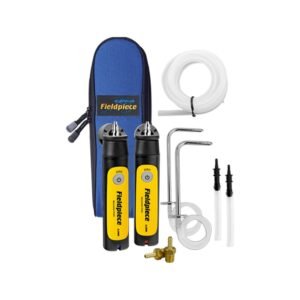
For example, our Fieldpiece JL3KM2 Manometer Probe Kit guide covers equipment designed for pressure measurements in suitable heating and HVAC applications.
The Fieldpiece measures pressure. The RIDGID CD-100 detects the relative presence of certain gases. Neither instrument replaces the other, and appropriate formal testing procedures remain essential.
For inaccessible service areas, a visual inspection tool may also be useful. Our Teslong Articulating Borescope guide explores a camera designed for examining concealed or difficult-to-reach spaces.
The important distinction is choosing the correct diagnostic instrument for the task rather than expecting one tool to answer every question.
The Drawbacks
The RIDGID CD-100 is a specialist instrument with useful features, but there are important limitations that professional users should understand.
It Does Not Measure Exact Gas Concentrations
Although the CD-100 responds to changes in combustible gas levels, it is not a precision gas analyser.
The LED indicators represent relative detection levels rather than exact numerical measurements.
A technician cannot use these indicators to establish the precise concentration of gas in an area.
The specified measuring range and sensitivity are based on methane, and responses to other gases may differ.
For work requiring documented concentration measurements, a suitable calibrated instrument is necessary.
It Cannot Identify Which Gas Is Present
The CD-100 detects several gases, including methane, propane and hydrogen, along with vapours from certain solvents.
However, it cannot determine which particular gas has triggered its sensor.
This means a response may need further professional investigation before its cause can be established.
Other substances in the working environment can complicate interpretation.
The detector provides an indication that needs to be understood in context, rather than a complete diagnosis by itself.
It Is Not a Personal Safety Monitor
This is an especially important limitation.
RIDGID specifically warns against using the CD-100 as a confined-space or personal safety device.
It is not a continuously operating household gas alarm, carbon monoxide alarm or substitute for equipment intended to monitor dangerous atmospheres.
Its absence of an alert must never be interpreted as proof that an environment is safe.
Suspected dangerous gas releases require the appropriate emergency procedures and qualified personnel, not continued investigation with a handheld detector in unsafe conditions.
Correct Calibration Conditions Are Essential
The automatic calibration feature is convenient, but it comes with a responsibility.
RIDGID states that the detector must be switched on and calibrated in an environment known to be free of combustible gases.
Starting the instrument in a contaminated atmosphere can lead to incorrect calibration and readings lower than the actual gas level.
That could result in a dangerous situation being overlooked.
The detector must also be inspected and checked for correct operation as instructed by the manufacturer before use.
The Sensor Has a Limited Service Life
Although the CD-100 is designed for professional use, its sensing element is not permanent.
RIDGID specifies an expected sensor life of approximately five years.
The sensor is replaceable, which is preferable to discarding the entire instrument when it fails.
However, replacement requires the appropriate RIDGID component and authorised servicing.
Sensor condition and routine instrument checks are therefore important considerations for long-term ownership.
A Handheld Detector Cannot Replace Formal Testing
Locating an area where combustible gas is present is not the same as proving a gas installation is sound.
The CD-100 cannot replace pressure testing, tightness testing or any other checks required by applicable regulations and professional procedures.
It also cannot repair a leaking connection or establish the safety of an installation.
For qualified professionals, it should be viewed as one diagnostic tool within a wider collection of properly selected testing equipment.
It Requires Careful Storage and Maintenance
The instrument should be kept clean, dry and protected from unnecessary damage.
RIDGID advises against immersing it in water or using aggressive cleaning products.
The flexible probe and sensing tip also need protection when the detector is carried among other tools.
Batteries must be replaced when required and removed for extended storage.
At approximately one pound, it is reasonably portable, but still takes up additional space in a technician’s tool bag.
For someone who rarely needs combustible gas detection, that may be difficult to justify.
Who It Suits Best
The RIDGID CD-100 is intended for qualified gas-service technicians, heating engineers, maintenance professionals and appropriately trained users who need to locate suspected combustible-gas leaks.
Its adjustable sensitivity and flexible probe make it particularly relevant to work around accessible gas fittings and service equipment.
The combination of audible, visual and vibration alerts also provides flexibility across different working environments.
For other professional installation and diagnostic equipment, explore our Plumbing & Heating guides, covering specialist tools for dependable trade work.
It is not intended for untrained household gas investigations or as a replacement for approved safety-monitoring and testing equipment.
Is the RIDGID CD-100 Worth Carrying?
The RIDGID CD-100 concentrates on a specific professional task and provides the features needed to perform it effectively.
Its flexible probe, adjustable sensitivity and three alert methods are practical rather than unnecessary additions.
The replaceable sensor and established RIDGID construction also support its suitability as a long-term professional tool, provided it is maintained correctly.
The limitations are equally important. It cannot identify the exact gas, measure precise concentrations or replace formal gas-safety procedures.
For appropriately qualified technicians who regularly investigate suspected combustible-gas leaks, the CD-100 is a useful, purpose-built instrument that deserves consideration.
As an Amazon Associate I earn from qualifying purchases.