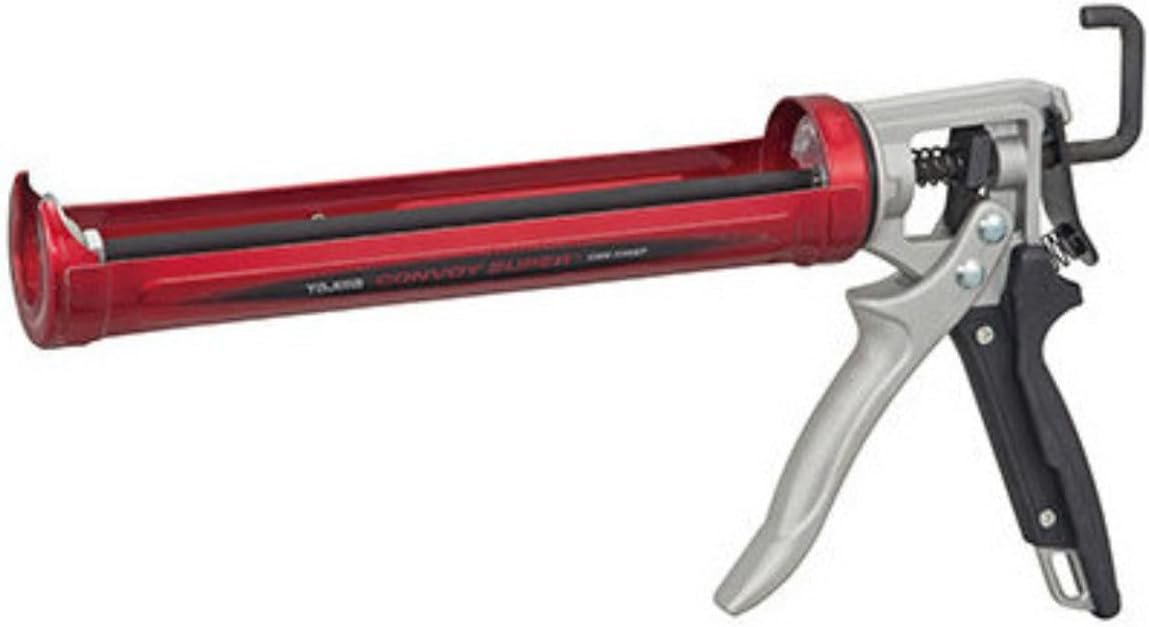
Tajima Convoy Super Caulking Gun
As an Amazon Associate I earn from qualifying purchases.
A good caulking gun is one of those tools that rarely attracts much attention until a poor one starts causing problems. Uneven pressure, unwanted dripping and awkward trigger movement can quickly turn a straightforward sealing job into a frustrating exercise.
The Tajima Convoy Super Caulking Gun is designed to address these everyday difficulties with solid construction, a 12:1 thrust mechanism, a rotating handle and an automatic flow-stop system.
It is a professional-style hand tool intended for controlled application of suitable sealants and adhesives, whether working around bathroom fittings, kitchen worktops, plumbing installations or general building joints.
Its design is particularly appealing to tradespeople who regularly work with cartridge sealants and want something more substantial than a basic disposable-quality applicator.
However, its longer construction and mechanical limitations mean it will not suit every job.
Why it works for plumbing and heating
Applying sealant neatly is an important part of many plumbing and heating installations.
Bath edges, shower enclosures, kitchen sinks, sanitary fittings and certain service penetrations all require careful sealing when appropriate to the installation.
The finished bead needs to be consistent, properly positioned and compatible with the surfaces involved.
A poor applicator can make that work unnecessarily difficult.
When the trigger moves unevenly or the plunger continues pushing after the handle is released, excess sealant can collect around the nozzle.
This creates mess and increases the amount of finishing work required.
The Tajima Convoy Super uses a four-point Twin-Thrust mechanism designed to provide strong, controlled pressure against the cartridge plunger.
Its 12:1 thrust ratio gives useful mechanical assistance when dispensing thicker materials.
The arrangement is especially relevant when working with sealants or compatible adhesives that require more pressure than an ordinary lightweight caulking gun can comfortably provide.
A rotating handle also makes it easier to adjust the working position as the nozzle moves around corners and changes direction.
For plumbing work, that can be useful when sealing around basins, baths and awkwardly positioned fittings.
The overall design concentrates on improving control rather than adding unnecessary features.
What it feels like to use
The Convoy Super has the unmistakable appearance of a professional manual caulking gun.
Its red steel barrel and sturdy trigger assembly give it a traditional trade-tool character.
Unlike lightweight plastic applicators, its construction is designed around repeated use and the mechanical forces involved in dispensing cartridge materials.
Tajima specifies a weight of approximately 710g for the CNV-100SP.
That gives the gun a noticeable presence in the hand without making it excessively heavy for ordinary sealing work.
The longer barrel supports the cartridge, while the metal trigger mechanism provides the leverage needed to advance the plunger.
The rotating handle is particularly interesting.
Rather than constantly twisting the wrist or repositioning the entire tool, the user can adjust the orientation to suit the direction of the joint.
This can be helpful when moving from a horizontal bead to a vertical one, or when following the edge of a fitting.
The handle and trigger still require deliberate pressure.
This is a manual tool, after all, and the resistance will depend partly on the viscosity of the material, the nozzle opening and the cartridge being used.
Nevertheless, the combination of steel construction and mechanical assistance gives it the purposeful design expected from a tool intended for regular professional work.
Twin-Thrust system and controlled dispensing
The Twin-Thrust system is one of the main reasons to consider the Convoy Super.
Tajima uses a four-point mechanism intended to distribute force effectively through the plunger assembly.
The specified 12:1 thrust ratio provides greater mechanical assistance than many simple low-ratio applicators.
This is particularly helpful when applying relatively stiff sealants.
Thicker materials can be tiring to dispense with an ordinary gun, especially when completing long joints or several installations in succession.
A suitable thrust mechanism makes it easier to maintain gradual pressure rather than squeezing the trigger aggressively.
That matters because consistent trigger movement contributes to a more even bead.
However, good results still depend on preparing the nozzle correctly.
Cutting the opening too large can release more material than required, while an opening that is too small can create unnecessary resistance.
The angle of the nozzle also affects how smoothly the sealant enters the joint.
The Tajima provides mechanical control, but careful preparation and application technique remain essential.
How the Auto Flow Stop system helps
One of the more thoughtful features of the Convoy Super is its Auto Flow Stop mechanism.
Conventional caulking guns can continue pushing sealant through the nozzle after the trigger is released.
This happens because pressure remains inside the cartridge.
The result is familiar to anyone who has spent time sealing bathrooms or kitchens: a small unwanted blob appears just as the tool is being moved away from the joint.
Tajima’s system is designed to reduce this problem by allowing the plunger to retract slightly after each trigger action.
That small movement helps relieve pressure and reduce continued material flow.
It is a useful feature when completing short beads, changing direction or moving between separate sealing points.
The mechanism can also help reduce wasted material and unnecessary cleanup.
However, the flow stop should not be mistaken for a guarantee that every sealant will stop immediately.
Very fluid materials, warm cartridges or excessive nozzle openings can still allow some material to escape.
The advantage is improved control, not complete immunity from dripping.
Useful around bathrooms and kitchens
The Convoy Super is especially relevant to the finishing stages of bathroom and kitchen installations.
Sealing around baths, basins and shower trays requires careful control, particularly when working against finished ceramic, acrylic or glazed surfaces.
The rotating handle can help maintain a comfortable working position as the applicator follows changes in direction.
The long barrel also keeps the cartridge supported while pressure is applied.
For kitchen work, the same basic principles apply to suitable sealant joints around worktops, splashbacks and certain sink installations.
Before applying a new bead, existing damaged material needs to be removed where necessary, and the joint must be prepared according to the sealant manufacturer’s instructions.
Using the correct sealant for the surfaces and intended exposure is just as important as choosing a good applicator.
For example, sanitary silicone and general-purpose construction adhesive serve different purposes and should not automatically be treated as interchangeable.
The Convoy Super is a dispensing tool rather than a solution to underlying water leaks or defective fittings.
Good preparation and correct installation always come first.
When plumbing work involves renewing pipework as well as finishing joints, our RIDGID 151 Quick-Acting Tubing Cutter guide explores a professional tool for accurate preparation of suitable metallic tubing.
Both tools illustrate the value of choosing equipment designed for a specific job rather than relying on inexpensive general-purpose alternatives.
Cartridge compatibility and everyday practicality
The CNV-100SP is designed for standard 10-fluid-ounce, approximately 300ml cartridges.
This makes it appropriate for many commonly available sealants and compatible adhesives sold in that format.
A built-in seal puncture pin is another useful detail.
It provides a convenient means of piercing suitable inner cartridge seals without searching for a separate pointed tool.
For regular installation work, these small conveniences can make a difference.
The combination of a supported cartridge, rotating mechanism and automatic pressure relief gives the gun a practical arrangement for repetitive sealing tasks.
There are no batteries to charge, no electronic controls to configure and no complicated operating modes.
The operator loads a suitable cartridge, prepares the nozzle and controls the material through the trigger.
That simplicity is attractive for a professional hand tool.
It also complements other mechanical equipment used around finished plumbing fittings.
Our KNIPEX 10-Inch Pliers Wrench guide covers another useful tool for installation work, particularly where smooth parallel jaws help protect suitable finished nuts and fittings.
A carefully chosen combination of cutting, gripping and sealing tools is usually more useful than expecting one piece of equipment to cover every task.
The drawbacks
The Tajima Convoy Super has several worthwhile features, but there are important limitations to consider before choosing it.
The long barrel can be awkward in confined spaces
The extra-long construction provides good cartridge support, but it also increases the amount of room needed to position the gun.
This matters particularly in plumbing work.
Sealing behind taps, beneath tightly positioned basins or around awkward pipe penetrations can leave very little working clearance.
Even with the rotating handle, there are situations where the barrel simply cannot be positioned at the required angle.
The rotating mechanism improves manoeuvrability, but it does not make the physical length of the tool disappear.
For extremely restricted work, a shorter applicator or a different sealant delivery system may be more convenient.
Anyone regularly working in compact vanity units or crowded service cupboards should consider this carefully.
It is heavier than basic applicators
At approximately 710g before a cartridge is fitted, the Convoy Super is not especially heavy for professional equipment.
However, its metal construction gives it more weight than some lightweight plastic or skeleton-frame alternatives.
That difference becomes more noticeable when working above shoulder height or maintaining an awkward position for an extended period.
Adding a full cartridge increases the working weight further.
For occasional small sealing jobs, the additional substance may be unnecessary.
The sturdy construction makes more sense when the tool is used regularly and its mechanical features justify carrying the extra weight.
The 12:1 thrust ratio is not ideal for every material
A higher thrust ratio helps when working with thicker sealants and adhesives.
However, very free-flowing products do not necessarily require that level of mechanical assistance.
With relatively soft materials, it can be easy to dispense more sealant than intended if excessive trigger pressure is applied.
The operator must still develop a controlled technique.
The gun also cannot compensate for a poorly prepared nozzle or an incorrectly selected cartridge.
A smaller opening may increase pressure requirements, while an oversized opening can make the flow difficult to manage.
The mechanical advantage is useful, but it should be matched to the material being dispensed.
Auto Flow Stop cannot completely eliminate dripping
Tajima’s automatic flow-stop mechanism is a practical feature, but its effect depends on the material and working conditions.
Cartridge pressure, sealant viscosity and temperature all influence what happens when the trigger is released.
Some materials may continue to emerge from the nozzle despite the slight plunger retraction.
This is particularly possible when the nozzle has been cut too widely or the material flows relatively easily.
It would therefore be unrealistic to expect perfectly clean stopping behaviour in every situation.
The system helps manage excess flow, but careful trigger control and sensible handling remain necessary.
It is limited to compatible cartridge sizes
The CNV-100SP is designed for approximately 300ml cartridge products.
It should not automatically be regarded as compatible with every sealant package.
Larger cartridges, bulk materials and flexible foil sausage packs may require completely different applicators.
Some specialist adhesives are also supplied in twin-cartridge systems that need dedicated mixing guns.
Professional users who work with several packaging formats may therefore need additional equipment.
Checking cartridge dimensions and product compatibility before ordering is important, especially when using less familiar sealant brands.
Manual operation still requires hand effort
The Twin-Thrust mechanism provides mechanical assistance, but it does not remove the need to squeeze the trigger repeatedly.
During a large installation, particularly when using stiff materials, hand fatigue can still become an issue.
The amount of force needed depends on the sealant formulation, temperature, nozzle preparation and number of joints being completed.
For an occasional bathroom or kitchen installation, manual operation is perfectly reasonable.
However, tradespeople applying large quantities of heavy construction adhesives throughout the day may find a powered dispensing system more convenient.
The Tajima is a capable manual applicator, not a replacement for every powered professional system.
The rotating handle takes some familiarity
The ability to rotate the handle is useful when changing the application angle.
However, anyone accustomed to a basic fixed-frame gun may need time to become comfortable with the arrangement.
The operator still needs to keep the nozzle correctly aligned with the joint while applying controlled pressure.
Poor hand positioning can produce uneven beads regardless of the rotation mechanism.
Practising on a suitable test surface before attempting a highly visible finished joint is sensible.
This is particularly important when working with sealants that are difficult to remove once cured.
Steel construction needs ordinary maintenance
The metal barrel and mechanism are designed for demanding use, but they should still be kept clean and protected.
Sealant residue can accumulate around the nozzle support, cartridge holder and moving parts.
Allowing adhesive to harden around the mechanism may make operation less smooth.
The gun should be cleaned using methods compatible with its materials and the sealant manufacturer’s recommendations.
It is also sensible to inspect the plunger mechanism and rotating assembly periodically.
Keeping the tool dry during storage helps preserve its condition.
Strong construction does not make a tool maintenance-free.
It cannot correct poor sealing preparation
Perhaps the most important limitation is that even an excellent caulking gun cannot compensate for incorrect joint preparation.
Applying new silicone over contaminated, damp or unsuitable surfaces may lead to poor adhesion.
A damaged joint, moving substrate or underlying plumbing defect also needs proper attention before sealing.
The gun controls how the material is dispensed.
It does not determine whether the sealant is suitable, whether the joint has been prepared correctly or whether the finished installation is watertight.
Those responsibilities remain with the person carrying out the work.
For this reason, the Convoy Super should be regarded as one component of a proper sealing process rather than a shortcut to professional results.
Who it suits best
The Tajima Convoy Super is particularly appealing to plumbers, heating engineers, bathroom installers, kitchen fitters and general building professionals who regularly apply cartridge sealants.
Its sturdy construction and 12:1 thrust mechanism make it suitable for users who want controlled manual dispensing without relying on a powered applicator.
The rotating handle is useful when moving around different joint angles, while the automatic flow-stop mechanism helps reduce unwanted material flow between applications.
It also makes sense for experienced home renovators who value durable tools and expect to undertake repeated sealing work.
For someone carrying out one very small repair, a simpler applicator may be sufficient.
The Convoy Super is easier to justify when comfort, consistent operation and long-term usefulness matter.
Clean working conditions are also important when preparing joints. Our DEWALT STEALTHSONIC Wet/Dry Vac guide explores an alternative piece of equipment for suitable workshop and installation cleanup tasks.
For more carefully chosen equipment used in installation, maintenance and repair work, explore our Plumbing & Heating guides.
Ultimately, the right tool depends on the type of sealant, the available working space and how frequently the job needs doing.
Is it worth the toolbox space?
The Tajima Convoy Super Caulking Gun is a thoughtfully designed professional applicator that concentrates on the details that matter during regular sealing work.
Its Twin-Thrust mechanism provides useful mechanical assistance, the rotating handle improves working flexibility and the Auto Flow Stop system helps control unwanted dispensing.
The steel construction gives it the substantial character expected from a dependable trade tool.
Its limitations are equally important.
The long barrel can be inconvenient in confined spaces, manual operation still requires effort and the cartridge capacity restricts the materials and packaging formats it can accommodate.
It is also not a substitute for correct preparation or good sealing technique.
For tradespeople and experienced renovators who regularly work with compatible cartridge sealants, however, the Convoy Super offers a sensible combination of strength, control and practical features.
It is the kind of straightforward specialist tool that earns its place by making a familiar job easier to manage, rather than by adding unnecessary complexity.
As an Amazon Associate I earn from qualifying purchases.