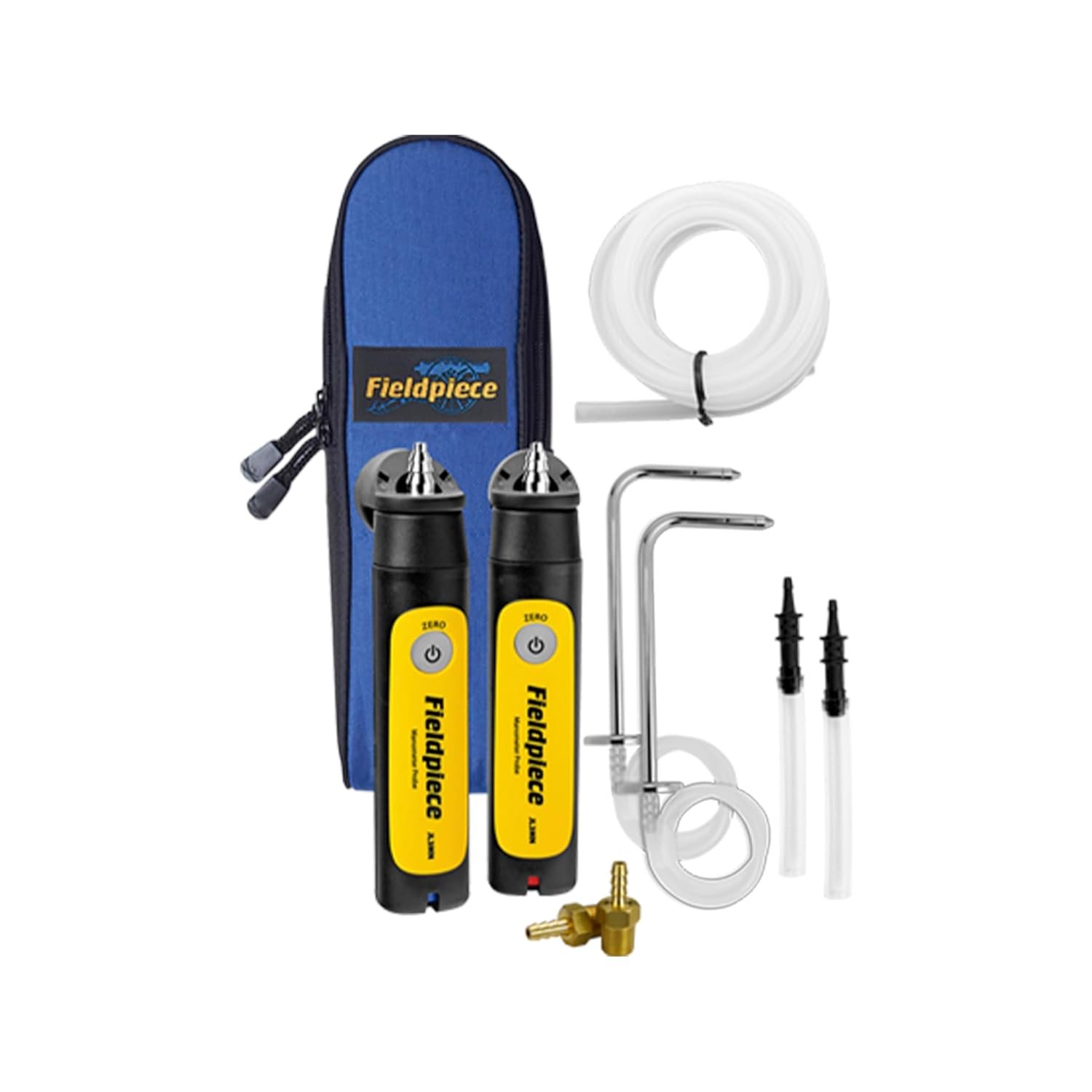
Fieldpiece JL3KM2 Manometer Probe Kit
As an Amazon Associate I earn from qualifying purchases.
The Fieldpiece JL3KM2 Manometer Probe Kit is designed for HVAC and heating engineers who regularly need pressure readings but would rather not spend the job running long lengths of tubing between test points.
Instead of putting both measurements into one conventional handheld manometer, Fieldpiece supplies two independent JL3MN wireless probes. Each probe can sit close to the point being measured while the readings are viewed through the Fieldpiece Job Link system.
That arrangement can be particularly useful for static-pressure measurements, gas inlet and outlet pressure, draft measurements and troubleshooting restrictions within an air system. The real benefit is not simply that the probes are wireless; it is that the measuring equipment can stay where the pressure actually needs to be checked while the engineer moves around the system.
Why it works for heating and HVAC diagnostics
With a traditional dual-port manometer, the meter and its tubing often dictate where you have to stand.
The JL3KM2 changes that arrangement. One probe can be positioned at one test point and the second somewhere else, with both measurements available together.
For heating and HVAC work, that can be useful when checking return and supply static pressure, total external static pressure, furnace gas pressure or draft.
It also reduces the amount of tubing stretched across equipment, floors and access panels.
The system can show the individual pressure readings as well as the difference between the two probes. That makes it useful when the relationship between two points matters more than either measurement by itself.
What the probes feel like to work with
The individual probes are compact rather than shaped like a large handheld meter.
Each weighs only a fraction of a pound, so there is relatively little bulk hanging from the test connection. They use standard AAA batteries rather than a sealed rechargeable battery pack.
That small size is important because the probes are intended to remain close to the measurement point.
Instead of holding a meter in one hand while trying to manage tubing and make adjustments with the other, the probe can stay in place while the reading follows you on the connected device.
The familiar yellow-and-black Fieldpiece housings feel much more like trade equipment than consumer electronics. They are chunky enough to handle with gloves without becoming unnecessarily large.
The padded case also makes sense because this is not simply a pair of probes. Hoses, fittings and static-pressure accessories need somewhere organised to live between jobs.
What comes in the kit
The JL3KM2 is supplied as a fairly complete working set rather than two bare probes.
You get two JL3MN manometer probes, two static-pressure probes with hoses, brass fittings, additional hose, gas adapters, four AAA batteries and a padded carrying case.
That matters because these accessories are part of what makes the kit useful on an actual job.
The static probes are suited to duct and equipment measurements, while the adapters allow the manometers to be connected for appropriate gas-pressure work.
It is much better than opening a box containing two expensive wireless probes and immediately having to order several additional fittings before they can do useful work.
Wireless readings through Job Link
The JL3KM2 works with Fieldpiece’s Job Link system.
Fieldpiece quotes a wireless range of up to around 1,000 feet under clear line-of-sight conditions. That is a maximum figure rather than something I would expect inside every plant room or building.
Metal equipment, walls, floors and other obstructions will naturally reduce wireless range.
The more useful benefit is simply being able to move away from the probes while continuing to see what is happening.
An engineer can make an adjustment elsewhere on the equipment and watch the pressure response without constantly walking back to the test points.
The wider Job Link system can also bring several compatible probes together, which becomes particularly useful when diagnosing more complicated airflow or refrigeration problems.
The equipment does not diagnose the fault for you. It simply makes it much easier to gather several measurements without constantly rearranging one meter.
Pressure range and accuracy
The probes can display readings in several commonly used pressure units, including inches of water column, millimetres of water column, millibar, psi and pascals.
The JL3MN probes are designed for low-pressure diagnostic work rather than being general-purpose high-pressure instruments.
Fieldpiece specifies particularly close accuracy around the lower static-pressure range, which is where many HVAC airflow measurements are taken.
That distinction matters because a manometer specification should not be reduced to one headline figure. Accuracy can vary across the working range, and the relevant specification depends on the pressure being measured.
The probes are designed for dry, non-corrosive gas.
That is an important limitation. They should not be treated as general plumbing pressure gauges simply because the display offers familiar pressure units.
Useful for static-pressure troubleshooting
Static-pressure work is one of the situations where the wireless design makes a lot of sense.
One probe can be positioned on the return side of the system and the other on the supply side. The engineer can then compare the readings and work with the resulting total external static pressure.
That is neater than running two long hoses back to one central meter.
The probes can also be repositioned around different sections of the system when investigating restrictions.
Filters, coils, ductwork and other components can all influence pressure relationships.
The JL3KM2 does not tell you which component is faulty. What it does is make the measurements easier to collect and compare.
For experienced engineers, that can save a surprising amount of moving around during a diagnostic job.
Gas and draft pressure work
The JL3KM2 can also be used for appropriate gas inlet, outlet and draft measurements.
Having two separate probes is useful when two pressure points need to be compared while an adjustment is being made.
The wireless system does not alter the fundamentals of safe gas work.
Correct competence, equipment isolation, suitable test points and proper working procedures remain every bit as important as they would be with a conventional manometer.
The advantage is physical convenience.
Instead of being tied to one display by several lengths of tubing, the probes remain at the measurement points while the display effectively moves with the engineer.
Battery life and everyday use
Each probe runs from two AAA batteries.
Fieldpiece gives a typical battery life of around 150 hours, and there is an automatic power-off function to help prevent batteries being wasted when a probe is accidentally left switched on.
There is something to be said for ordinary replaceable batteries in professional test equipment.
A rechargeable instrument is convenient until it goes flat halfway through a job. With AAA batteries, a spare set in the tool case gets you working again immediately.
Of course, that only works if you remember to carry spares.
For regular trade use, keeping an unopened set in the case would be sensible.
The drawbacks
The biggest drawback is dependence on a phone or tablet.
The probes do not give you the conventional large display of a standalone digital manometer. Their full usefulness depends on the Fieldpiece Job Link system and a compatible mobile device.
For someone already using Job Link probes, clamps and other Fieldpiece equipment, that integration may be exactly what they want.
For an engineer who prefers a completely self-contained instrument, it may feel like unnecessary complication.
A phone introduces another piece of equipment that has to be charged, protected and kept within reach.
Bluetooth or wireless communication needs to be working correctly. The app needs to remain compatible with the device, and the phone needs somewhere sensible to sit when the engineer is working around dusty, hot or cramped equipment.
The quoted wireless range also needs perspective.
A maximum line-of-sight range sounds impressive, but buildings rarely provide ideal line-of-sight conditions. Plant rooms, sheet-metal ductwork, walls, floors and equipment can all interfere with wireless communication.
For most engineers, dependable communication across an ordinary working area matters much more than achieving the maximum advertised range.
The kit is also quite specialised.
If you only take an occasional pressure measurement, a straightforward conventional manometer may be quicker, cheaper and easier to live with.
The value of having two independent wireless probes becomes much clearer when pressure diagnosis forms a regular part of the working day.
The measurement medium is another important limitation.
These probes are intended for dry, non-corrosive gas. They are not general-purpose instruments for connecting to water systems or other liquids.
Someone coming from plumbing rather than HVAC could easily see the pressure range and assume the probes have wider applications than they actually do.
The hoses and fittings also create a little housekeeping.
Static probes, brass fittings, gas adapters and short lengths of hose are exactly the kind of small components that disappear into tool bags if they are not returned to the case.
The padded case helps, but this remains a multi-piece kit rather than one instrument you can throw into a toolbox.
AAA batteries are both a strength and a weakness.
They are easy to replace, but with two probes you are monitoring four batteries rather than one rechargeable tool.
The quoted battery life is generous, yet a probe will eventually go flat, and it will probably choose an inconvenient moment to do it.
There is also the danger of relying too heavily on the digital side of the system.
Being able to display several readings together is useful, but more numbers do not automatically create a better diagnosis.
Eight readings collected from the wrong points are still eight unhelpful readings.
The technician still has to understand the system, know where measurements should be taken and interpret the pressure relationships correctly.
The JL3KM2 does not replace experience.
For very simple jobs, the two-probe arrangement can actually feel slower than a conventional manometer.
If you only want one quick differential measurement at arm’s length, connecting two wireless probes and opening an app may seem excessive compared with putting two hoses onto one handheld meter.
The wireless approach earns its keep when the measurement points are awkward, separated or need to remain monitored while adjustments are made elsewhere.
There is also some ecosystem lock-in to consider.
Once you start buying Fieldpiece wireless probes, clamps and related Job Link equipment, staying within the same system becomes increasingly convenient because everything works together.
That can be an advantage, but it also means the value of each individual tool becomes partly tied to the wider Fieldpiece platform.
Someone already heavily invested in another manufacturer’s wireless test equipment may have little reason to change systems simply for these probes.
The compact size can create another practical problem: they are easier to leave behind.
A large manometer sitting prominently beside the equipment is difficult to forget. A small wireless probe tucked behind an access panel or hanging from a short hose is much easier to overlook at the end of a job.
Anyone using them regularly will probably develop a habit of physically counting both probes before closing the case.
Finally, the technology should never create a false sense of safety.
Gas and combustion-related pressure work remains safety-critical. Wireless measurements may make the physical process cleaner and easier, but they do not reduce the need for proper training, correct procedures and careful interpretation.
Most of these drawbacks are not faults in the JL3KM2 itself.
They are the compromises that come with replacing one traditional handheld meter with two separate wireless measuring probes and an app-based display.
Who it suits best
The Fieldpiece JL3KM2 makes most sense for HVAC technicians, heating engineers and service professionals who regularly carry out pressure diagnostics.
It should be particularly useful for engineers who already use other Fieldpiece Job Link equipment.
Anyone regularly checking supply and return static pressure, investigating airflow restrictions, measuring gas pressure or carrying out draft testing is more likely to appreciate the freedom of leaving the probes at the test points.
For someone taking pressure readings only occasionally, a conventional handheld manometer may remain the simpler choice.
Is it worth the tool-case space?
The Fieldpiece JL3KM2 Manometer Probe Kit is not really about using wireless technology simply because wireless sounds modern.
Its benefit is practical.
Put each probe close to the measurement point, keep the hoses short, move around the equipment and continue seeing both readings.
The complete kit provides two wireless probes together with the static-pressure accessories, hoses, fittings, gas adapters, batteries and carrying case needed for real diagnostic work.
The disadvantages are equally clear.
You need a compatible mobile device, wireless range depends on the environment, batteries still need managing, and the probes are intended for dry non-corrosive gas rather than every type of pressure measurement.
For an engineer who regularly carries out this kind of testing, though, separating the pressure probes from the display can make awkward diagnostic work noticeably tidier and more flexible.
For more professional heating and diagnostic equipment, explore our Plumbing & Heating guides on Zennh.
As an Amazon Associate I earn from qualifying purchases.