AIRZILLA Retractable Air Hose Reel
As an Amazon Associate I earn from qualifying purchases.
The AIRZILLA Retractable Air Hose Reel is designed to solve one of those small workshop annoyances that becomes surprisingly tiresome over time: dragging an air hose across the floor, untangling it before a job and then coiling it again afterwards.
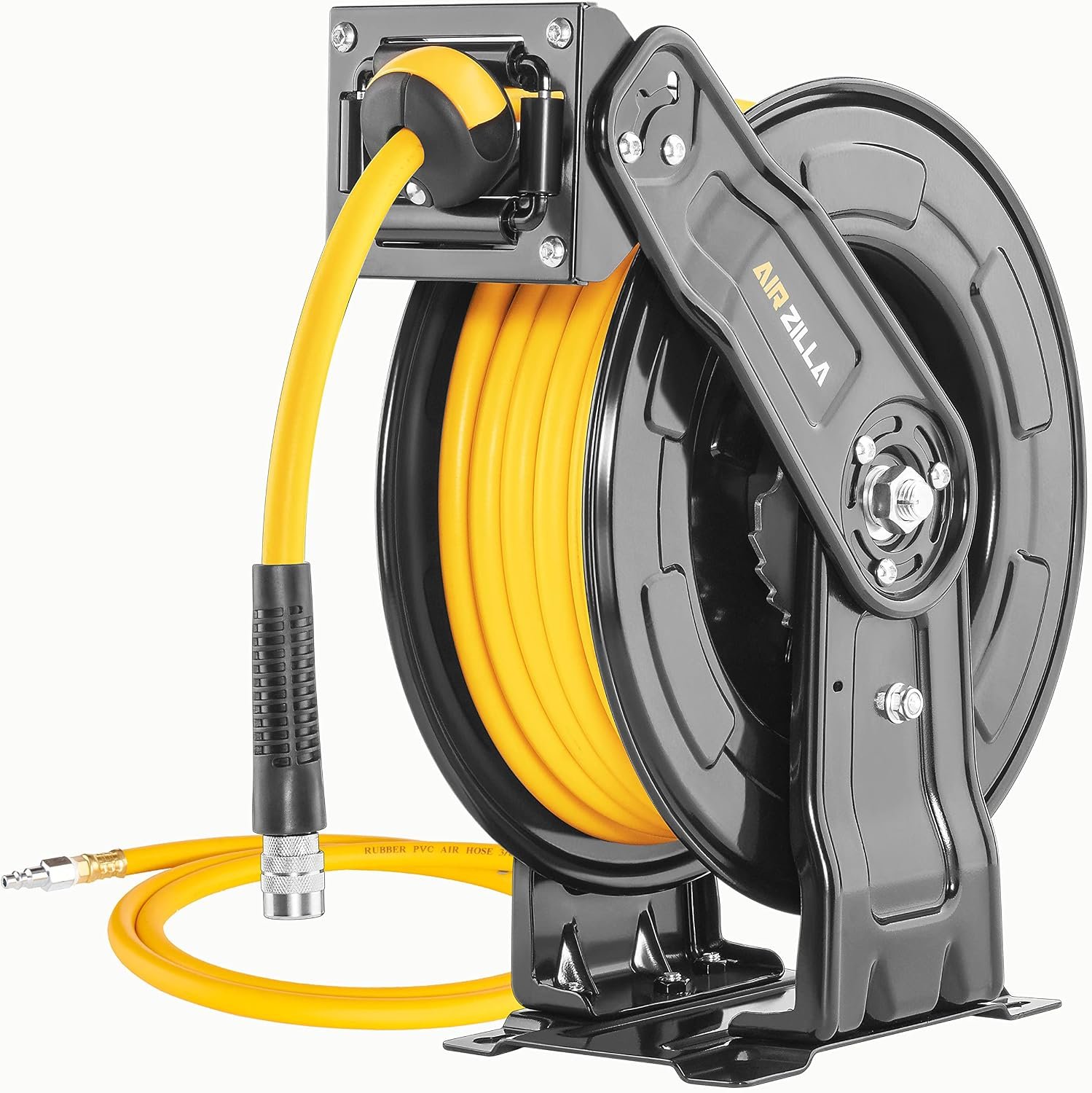
This 3/8-inch version uses a 65-foot hybrid polymer working hose, mounted on a heavy-gauge steel reel with a dual-arm frame. AIRZILLA also supplies a lead-in hose, automatic rewind mechanism and brass air connections, creating a permanently mounted air line rather than something that has to be unpacked every time the compressor is used.
Why it works in a workshop
The biggest attraction is simply organisation.
A conventional loose air hose tends to migrate around a workshop floor. It gets caught around benches, pushed underneath equipment and eventually ends up coiled somewhere inconvenient. A retractable reel gives the hose a permanent home while keeping a substantial working length available.
AIRZILLA uses a heavy-gauge industrial steel frame with a powder-coated finish intended to resist corrosion. The dual-arm design supports the reel from both sides rather than hanging the drum from a single support.
Physically, it has the solid, mechanical feel you would expect from workshop equipment rather than lightweight household storage. The black steel frame surrounds the bright yellow hose, and the open-drum construction means you can see exactly how the hose is winding back onto the reel.
That exposed mechanical design also suits a working garage or workshop visually. It looks like equipment rather than something trying to disappear into the décor.
What the hose feels like to use
The supplied hose is a hybrid polymer construction, rather than traditional rubber or rigid PVC.
AIRZILLA rates it for conditions from -40°F to 176°F and for working pressures up to 300 PSI. The manufacturer also describes it as resistant to water, oil, heat and weather.
Hybrid polymer is useful here because flexibility matters almost as much as pressure capability. A stiff hose fights against you as you move around a vehicle or workbench; a more flexible line is easier to route around corners and less inclined to retain a tight coil.
The 65-foot working length also gives plenty of reach for many home workshops, garages and small professional spaces. Instead of moving the compressor around the room, the compressor can remain in one position while the hose is pulled to the job.
At the connection end, AIRZILLA uses 1/4-inch NPT brass fittings, with an integrated brass outlet arrangement intended to reduce leakage.
Automatic rewind and hose control
The reel uses a familiar ratchet-style locking system.
Pull the hose out and the internal mechanism allows it to lock at the chosen length. A short additional pull releases the ratchet so the spring can retract the hose back onto the drum. AIRZILLA describes the mechanism as allowing the hose to lock at different working positions rather than forcing you to use the entire length every time.
That matters in everyday use.
If you only need ten or fifteen feet to reach a workbench, there is no reason to have the remaining hose lying across the floor. Pull out what is needed, let it lock, complete the job and then allow it to rewind.
Four non-snag rollers guide the hose as it enters and leaves the reel. Their purpose is to reduce abrasion as the hose is pulled from different angles rather than repeatedly rubbing against the edge of the steel frame.
The guide arm itself can also be repositioned to suit the way the reel is installed.
Wall, ceiling or floor mounting
AIRZILLA designed the reel for wall, ceiling or floor mounting, which gives some useful flexibility when planning a workshop.
Wall mounting will probably be the natural choice in many garages because it keeps both the reel and hose away from floor space. Ceiling mounting can work particularly well where wall space is already occupied by cabinets, shelving or tool storage.
Floor mounting is another possibility where a permanent air station is being built around a compressor.
Whichever position is chosen, this is not something to mount casually. The steel reel, spring mechanism and repeated pulling force from a long hose need an appropriately solid fixing surface. Proper installation matters far more here than it would with a lightweight extension lead or small hand-tool holder.
Once installed, though, the idea is very simple: the hose stays connected and ready rather than needing to be fetched and connected every time pneumatic equipment is required.
Useful with more than one air tool
A permanently mounted hose reel becomes particularly useful in a workshop where compressed air does several jobs.
An impact wrench, tyre inflator, blow gun, pneumatic nailer or other air tool can all make use of the same line, assuming the compressor and hose specification are appropriate for the particular tool.
The 3/8-inch hose size gives the reel a more workshop-oriented character than a very narrow lightweight airline. It is intended to provide a useful balance between airflow, flexibility and overall bulk.
And because the hose retracts when finished, occasional pneumatic-tool use becomes less of a nuisance. You are not left wondering whether it is worth dragging out a long loose hose simply to blow dust from a workbench or inflate a tyre.
The drawbacks
The first drawback is installation.
A portable air hose can be connected and used immediately. This reel needs a permanent location, and that position needs enough structural strength to cope with the weight of the steel unit and the repeated force of pulling a long hose against its spring.
That means some planning. Mounting it in the wrong place can leave the hose constantly crossing a doorway or work area, while mounting it too high or too far from the compressor may make the lead-in arrangement awkward.
The second issue is that the open steel reel is quite substantial. This is not an enclosed plastic cassette that blends discreetly into the corner of a garage. The drum, frame and hose remain visible, so you need enough wall, ceiling or floor space to accommodate it properly.
The open design also means the hose and mechanism are more exposed to workshop dust and grime than they would be inside a fully enclosed housing. That makes occasional inspection and cleaning sensible, especially in woodworking or other dusty environments.
Then there is the rewind mechanism itself.
Automatic retraction is convenient, but a 65-foot hose should not simply be released and allowed to race uncontrolled back toward the reel. Guiding the hose as it retracts is the more sensible approach. It helps the hose wind more evenly and reduces the chance of the coupling whipping around near the operator or nearby equipment.
The ratchet mechanism also takes a little familiarity. Anyone accustomed to manually coiling a hose may need a few uses to get used to finding the lock point and then giving the correct short pull to release it.
Another consideration is the fixed hose specification. You are buying this particular reel because you want a 3/8-inch hybrid polymer hose and its associated pressure capability. Someone running equipment with unusually high airflow requirements should still check the air consumption of their tools, compressor output and full airline setup rather than assuming that any 3/8-inch hose automatically suits everything.
The temperature and 300 PSI figures are manufacturer ratings, but they do not remove the need to work within the ratings of every other fitting, coupler, regulator and tool in the system.
The 65-foot length can also be more than some workshops need. Extra reach is useful, but a small single-car garage may never use most of it. A shorter reel could occupy less space and provide all the working distance required.
Conversely, a very large workshop may still need careful positioning to ensure 65 feet reaches every intended working area.
The hybrid polymer hose is another compromise rather than an automatic advantage over every other material. Its flexibility is attractive, particularly across a broad temperature range, but some tradespeople have strong preferences for traditional rubber hose because of the way it lies on the floor and feels in the hand. Material preference is worth considering if you use compressed air every day.
AIRZILLA is also not one of the traditional workshop names with decades of familiarity behind it. The construction and specification of this particular reel are convincing, but buyers who place a great deal of importance on long-established industrial dealer networks or extensive spare-parts support may naturally compare it with established professional reel manufacturers before deciding.
Finally, a retractable reel introduces more moving parts than a plain length of hose. There is a spring, ratchet, drum and roller system doing work every time the hose is extended or returned. That convenience is precisely why you buy the reel, but mechanically it will always be more complicated than simply hanging a loose hose on a wall hook.
Those are not reasons to dismiss it. They are the practical trade-offs for gaining a much tidier and faster-to-use air setup.
Who it suits best
The AIRZILLA reel makes the most sense in a garage, home workshop or working shop where compressed air is used regularly.
Someone who repeatedly uses an impact wrench, inflator, air gun or pneumatic tools will probably appreciate being able to pull down the required length of hose and get straight to work.
It is also useful for anyone trying to improve workshop organisation. Keeping a long air hose off the floor removes one more trip hazard and stops the hose becoming tangled around other equipment.
For someone who only connects an air compressor once or twice a year, however, permanent steel hose-reel installation may be unnecessary. A conventional loose hose will take less space and require no mounting.
Is it worth the workshop space?
The AIRZILLA Retractable Air Hose Reel has a straightforward job: make compressed air easier to access while keeping a long hose under control.
The dual-arm steel frame, 65-foot hybrid polymer hose, 300 PSI rating, brass connections, four guide rollers and automatic rewind system give it a convincing workshop specification.
It does require proper mounting, occupies permanent space and has more mechanical complexity than a loose hose. Those drawbacks are worth taking seriously.
But in a workshop where compressed air is used regularly, having the hose mounted, connected and ready to pull into service can make the whole air system feel considerably tidier and less cumbersome.
For more practical workshop equipment and storage ideas, explore our Workshop guides on Zennh.
As an Amazon Associate I earn from qualifying purchases.