RIDGID 151 Quick-Acting Tubing Cutter
As an Amazon Associate I earn from qualifying purchases.
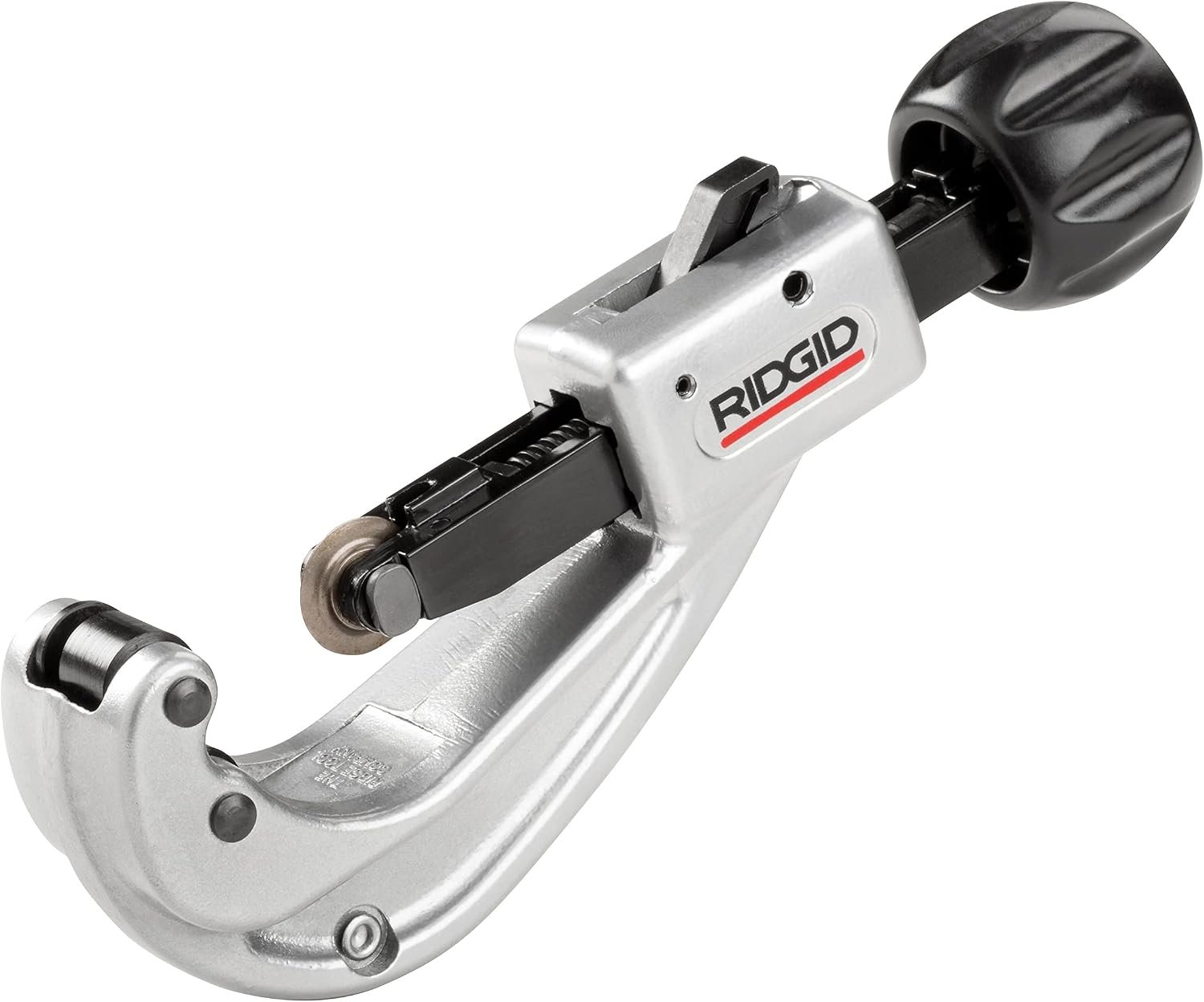
The RIDGID 151 Quick-Acting Tubing Cutter is a professional pipe-cutting tool designed for plumbers, heating engineers and tradespeople who regularly work with copper and other suitable metallic tubing.
With its substantial I-beam construction, quick-acting adjustment mechanism and integrated fold-away reamer, the Model 151 combines several practical features in one dependable-looking hand tool.
Its cutting capacity covers tubing from 6mm to 42mm outside diameter, making it suitable for a broad range of domestic and light commercial plumbing applications.
Unlike smaller close-quarters cutters, the RIDGID 151 provides a larger adjustment knob and a more substantial frame. This arrangement is particularly appealing when moving repeatedly between different pipe sizes during installation work.
The replaceable cutting wheel, integrated spare wheel and serviceable construction are equally important. Professional tools need to remain useful beyond the life of their original cutting components.
For anyone who values well-engineered equipment rather than disposable tools, the RIDGID 151 is an interesting addition to a plumbing toolkit.
Why It Works for Plumbing and Heating
Accurate pipe cutting is fundamental to good plumbing and heating work.
Whether preparing copper pipe for compression fittings, soldered connections or compatible press-fit systems, the quality of the cut affects the preparation required afterwards.
A suitable rotary tubing cutter helps produce an even, square cut without the rough saw marks associated with a hurried hacksaw cut.
The RIDGID 151 is designed around this type of work.
Its hardened cutting wheel travels around the circumference of the tube, gradually separating the material as controlled pressure is applied.
The quick-acting mechanism makes it easier to position the cutting wheel against different tube diameters without repeatedly winding the adjustment screw through its entire range.
This is particularly useful when working with several sizes of copper tubing during the same installation.
A larger adjustment knob provides a convenient gripping surface, while the rigid supporting frame helps maintain the relationship between the cutting wheel and guide rollers.
For repetitive pipe preparation, these details can make an ordinary manual cutter considerably more practical.
What It Feels Like to Use
The RIDGID 151 has the solid, mechanical character expected from a professional tubing cutter.
Its I-beam construction provides substantial support without relying on an excessively bulky solid frame.
The metal body, hardened wear surfaces and sturdy sliding mechanism are designed for repeated adjustment and cutting.
Weighing approximately 560g, the tool is noticeably more substantial than a compact mini cutter.
That additional weight contributes to its trade-focused character, although it also means the cutter is less convenient when working in particularly awkward positions.
The X-CEL adjustment knob is one of the most appealing details.
Its larger diameter provides a generous gripping surface when advancing the cutting wheel against the tubing.
This is useful when hands are slightly damp or when gloves make smaller adjustment wheels difficult to handle.
The cutting mechanism is intended to move smoothly through its adjustment range, with the wheel and rollers keeping the tube correctly positioned.
There is also a fold-away reamer built into the tool.
Rather than carrying a separate small deburring tool for every straightforward job, the operator has a means of removing the internal cutting burr immediately after separating the tube.
The overall design is practical and deliberately mechanical, with few unnecessary complications.
Quick-Acting Adjustment Saves Repetitive Work
The quick-acting mechanism is one of the main reasons to consider the Model 151.
Traditional screw-feed pipe cutters often require several turns of the adjustment knob simply to open or close the cutter around different pipe diameters.
That is manageable when making an occasional cut.
However, during a plumbing installation involving several tube sizes, repeated adjustment can become tedious.
The RIDGID 151 allows the sliding carriage to be repositioned more quickly before the final cutting pressure is applied.
This reduces the amount of adjustment needed when moving between different pipes.
The X-CEL knob then provides controlled pressure on the cutting wheel.
The result is a more convenient arrangement for regular professional work.
Importantly, the quick-acting mechanism does not remove the need for careful cutting.
Once the wheel is positioned, pressure should be increased gradually as the cutter rotates around the tube.
Excessive tightening can deform the pipe or place unnecessary strain on the cutting wheel.
The best results still depend on keeping the cutter square to the tubing and allowing the wheel to do its work.
Cutting Capacity and Suitable Materials
The RIDGID Model 151, catalogue number 31632, has a specified cutting capacity of 6–42mm outside diameter.
This covers a useful range of tubing sizes for plumbing, heating and related mechanical installations.
The standard cutter is intended for suitable metallic tubing, including copper, brass and aluminium.
These materials are commonly encountered in domestic plumbing, refrigeration and general service work.
The cutter uses RIDGID’s E-3469 cutting wheel.
It is important to distinguish this model from other cutters in the RIDGID range.
The manufacturer offers separate versions for plastic tubing, multilayer pipe and corrugated stainless steel.
Although their frames may look similar, the cutting wheels and intended applications differ.
A standard metal-tubing cutter should not automatically be treated as suitable for every pipe material.
Selecting the correct tool and wheel helps protect both the tubing and the cutting mechanism.
The X-CEL Cutting Wheel System
Cutting wheels eventually wear, regardless of how well a tubing cutter is constructed.
Frequent use, inappropriate materials or excessive cutting pressure can gradually affect the condition of the wheel.
RIDGID addresses routine replacement through its X-CEL wheel system.
The cutter uses a quick-change wheel pin with a ball-detent arrangement, allowing the wheel to be changed without the usual small retaining clips.
This is a sensible feature for equipment that may be used repeatedly throughout the working week.
The adjustment knob also contains a spare cutting wheel.
Having a replacement stored directly in the tool is convenient when the fitted wheel becomes damaged or worn.
It reduces the likelihood of an otherwise serviceable cutter becoming unusable simply because a replacement part is not immediately available.
Before fitting a new wheel, the operator should check that the replacement is appropriate for the cutter model and intended tubing material.
The wheel should also be inspected for correct seating and free rotation before cutting begins.
These are small maintenance considerations, but they contribute to dependable long-term ownership.
Why the Built-In Reamer Matters
Cutting copper or other suitable metal tubing with a rotary cutter can leave a raised burr around the inside of the tube.
This occurs because the cutting wheel applies inward pressure as it gradually separates the material.
That internal ridge should not simply be ignored.
Depending on the installation, an unremoved burr can interfere with proper pipe preparation, create an obstruction or leave an undesirable edge within the tube.
The RIDGID 151 includes a fold-away reamer for removing the burr after cutting.
This makes the tool more convenient than a basic cutter without any deburring provision.
The reamer folds into the body when not required, reducing the number of exposed components during storage.
However, proper pipe preparation involves more than removing a single internal ridge.
The pipe should still be inspected for roundness, cleanliness, damage and compatibility with the intended fitting.
For press-fit systems, the fitting manufacturer’s instructions must be followed carefully.
A clean cut is only the beginning of a properly prepared connection.
A Useful Tool for Press-Fit Installations
Modern press-fit systems have made careful pipe preparation particularly important.
The tube must be cut squarely, deburred where required and checked before insertion into a compatible fitting.
The RIDGID 151 can form part of this preparation process when used with suitable metallic tubing.
Its controlled rotary cutting action makes it useful for producing the clean pipe ends needed before fitting assembly.
However, it does not replace the specialist equipment required to create the finished connection.
For professional installers working with compatible copper press systems, our Milwaukee M12 FORCE LOGIC Press Tool article explores a separate piece of equipment designed for making press-fit joints.
The distinction is important.
The RIDGID prepares the tube, while the correct pressing equipment and compatible jaws complete the connection.
Both stages require appropriate tools and care.
Everyday Maintenance and Tool Life
One of the advantages of a traditional mechanical tubing cutter is that routine maintenance is relatively straightforward.
There are no batteries, electronic controls or charging arrangements to consider.
The cutting wheel, rollers, adjustment mechanism and sliding components are the main areas that need attention.
Keeping the tool clean helps prevent accumulated metal particles and dirt from interfering with its movement.
The cutting wheel should be inspected periodically for chips, excessive wear or damage.
A wheel that no longer cuts cleanly should be replaced rather than compensated for by applying additional pressure.
The adjustment mechanism should also be kept free from debris and maintained according to RIDGID’s instructions.
When stored in a toolbox, protecting the cutting wheel from impacts helps preserve its condition.
The Model 151’s replaceable components are a useful part of its design.
Instead of treating the complete tool as disposable when a cutting wheel eventually wears out, the affected component can be replaced.
The Drawbacks
The RIDGID 151 is a substantial professional tubing cutter, but it is not the ideal tool for every plumbing situation.
Its size, cutting method and material limitations are important considerations, particularly for tradespeople who regularly work inside restricted service spaces.
Too Large for Some Confined Spaces
The most obvious limitation is the clearance needed to rotate the cutter around the pipe.
The RIDGID 151 has a larger frame than a close-quarters tubing cutter.
That becomes a disadvantage when working behind radiators, beneath floorboards, close to walls or between tightly spaced pipes.
Although the quick-acting adjustment makes positioning easier, it does not reduce the space required for the tool to rotate.
If a pipe runs close to a wall, the supporting frame may contact the surface before a full cutting rotation is possible.
For those situations, a compact close-quarters cutter may be a better choice.
The RIDGID 151 is most practical where there is sufficient access around the tubing.
It Is Relatively Heavy
At approximately 560g, the Model 151 has more weight than a basic miniature pipe cutter.
That substantial construction is attractive for regular workshop and installation work.
However, it becomes less convenient when cutting above shoulder height or working at an awkward angle.
Holding the cutter while rotating it around horizontal pipework can become tiring during repetitive tasks.
The additional weight may also be unnecessary for someone who only occasionally cuts small-diameter domestic copper pipe.
A lighter cutter can be easier to handle when access and working position are the main concerns.
It Can Leave an Internal Burr
Like other conventional rotary tubing cutters, the RIDGID 151 can produce an internal burr.
The included reamer is useful, but the operator must still take time to remove the unwanted material properly.
This is particularly important when preparing tube ends for fittings that require clean, correctly finished surfaces.
Simply cutting through the pipe does not mean the end is ready for assembly.
The reamer also needs sufficient access to operate.
In a very restricted space, a separate deburring tool may still be more convenient.
Anyone expecting completely burr-free results without further preparation may be disappointed.
Excessive Pressure Can Damage the Tube
A larger adjustment knob makes it easier to apply cutting pressure.
However, this also makes it possible to overtighten the cutting wheel.
Excessive pressure can distort softer tubing, create a more pronounced internal ridge or place unnecessary strain on the cutting components.
This is particularly relevant when working with thinner-walled material.
The cutter should be advanced gradually rather than tightened aggressively after every rotation.
Good technique remains essential, regardless of the quality of the tool.
Not Suitable for Every Pipe Material
The standard Model 151 is designed for suitable metallic tubing.
It should not be treated as a universal cutter for plastic, multilayer, steel and corrugated stainless steel pipe.
RIDGID manufactures separate cutter variants and cutting wheels for different materials.
Selecting the wrong version can produce poor results or damage the cutting wheel.
For plumbers who routinely work with copper, PEX, multilayer and other piping systems, this means carrying more than one type of cutting tool.
The standard 151 is best purchased for the materials it is specifically designed to handle.
The Maximum Capacity Is 42mm
The 6–42mm range covers many everyday applications, but it has a definite upper limit.
Larger commercial and industrial pipework may require another tubing cutter.
Attempting to use the Model 151 beyond its specified capacity is not appropriate.
Tradespeople who regularly work with larger tube sizes should consider whether the RIDGID 152 or another suitable cutter would offer the required range.
The 151 is useful because of its balance between capacity and manageable size, not because it can handle every diameter.
Replacement Wheels Are Still Necessary
Although the X-CEL system makes cutting-wheel replacement convenient, it does not eliminate wheel wear.
A damaged or blunt cutting wheel may produce rougher results, increase cutting effort or encourage excessive tightening.
The spare wheel stored in the knob is a thoughtful feature, but it is still a consumable component.
Professional users should keep suitable replacements available when the cutter is used regularly.
The quick-change system also requires care when removing and refitting the wheel.
Ensuring the pin is correctly secured and the wheel rotates freely is essential before returning the tool to service.
The Reamer Is Convenient but Not Always Ideal
The integrated fold-away reamer is useful for straightforward pipe preparation, but it is relatively small.
For occasional deburring, this arrangement saves reaching for another tool.
However, tradespeople preparing large numbers of tube ends may prefer a dedicated deburring tool designed specifically for the material and pipe size being used.
The integrated reamer also adds another component that must be kept clean and protected from damage.
Its presence is helpful, but it does not replace every specialist pipe-preparation tool.
It Is More Tool Than Occasional Users Need
The RIDGID 151 is designed around repeated professional use.
Its substantial construction, quick adjustment and serviceable cutting system are particularly valuable when pipe cutting forms a regular part of the working day.
Someone making one or two small copper pipe cuts each year may not take full advantage of those features.
A compact cutter could meet their needs while occupying considerably less toolbox space.
For professional plumbers and heating engineers, however, the extra construction and convenient adjustment mechanism are easier to justify.
The key is choosing a tool that matches the frequency and type of work being undertaken.
Who It Suits Best
The RIDGID 151 is particularly suitable for professional plumbers, heating engineers, mechanical installers and maintenance technicians who regularly cut suitable metallic tubing.
Its quick-acting adjustment makes it appealing when moving between different tube diameters, while the sturdy frame and replaceable cutting wheel suit repeated work.
It is especially useful for installers who value serviceable tools and prefer traditional mechanical equipment without batteries or unnecessary complications.
However, those regularly working inside tight cupboards or between closely spaced pipes may need a smaller cutter alongside it.
For completing plumbing connections after pipe preparation, our KNIPEX 10-Inch Pliers Wrench article explores a complementary tool with smooth parallel jaws for gripping suitable nuts and finished fittings without the tooth marks associated with ordinary serrated pliers.
Together, properly selected cutting and gripping tools provide a more practical approach than expecting one tool to perform every job.
Is the RIDGID 151 Worth the Plumbing Tool Bag Space?
The RIDGID 151 Quick-Acting Tubing Cutter offers a convincing combination of traditional mechanical construction and practical improvements.
Its substantial I-beam frame, X-CEL adjustment mechanism, replaceable cutting wheel and integrated reamer make it particularly suitable for regular pipe preparation.
The quick-acting carriage is useful when switching between different tube sizes, while the spare cutting wheel and serviceable components support long-term ownership.
Its limitations are equally clear.
The cutter requires sufficient working clearance, is heavier than a compact alternative and remains intended for specific tubing materials and diameters.
It also requires proper technique and deburring after cutting.
For professional plumbers and heating engineers who regularly work with suitable metallic tubing, the RIDGID 151 is a sensible addition to a well-equipped toolkit.
It does not attempt to replace every specialist cutter. Instead, it concentrates on doing an essential plumbing task accurately, consistently and with equipment designed for repeated use.
Explore more carefully selected trade equipment in our Plumbing & Heating collection.
As an Amazon Associate I earn from qualifying purchases.