Klein Tools 80028 Electrician Tool Kit
As an Amazon Associate I earn from qualifying purchases.
The Klein Tools 80028 Electrician Tool Kit brings together a substantial collection of professional hand tools, electrical testing equipment and organised storage in one complete package.
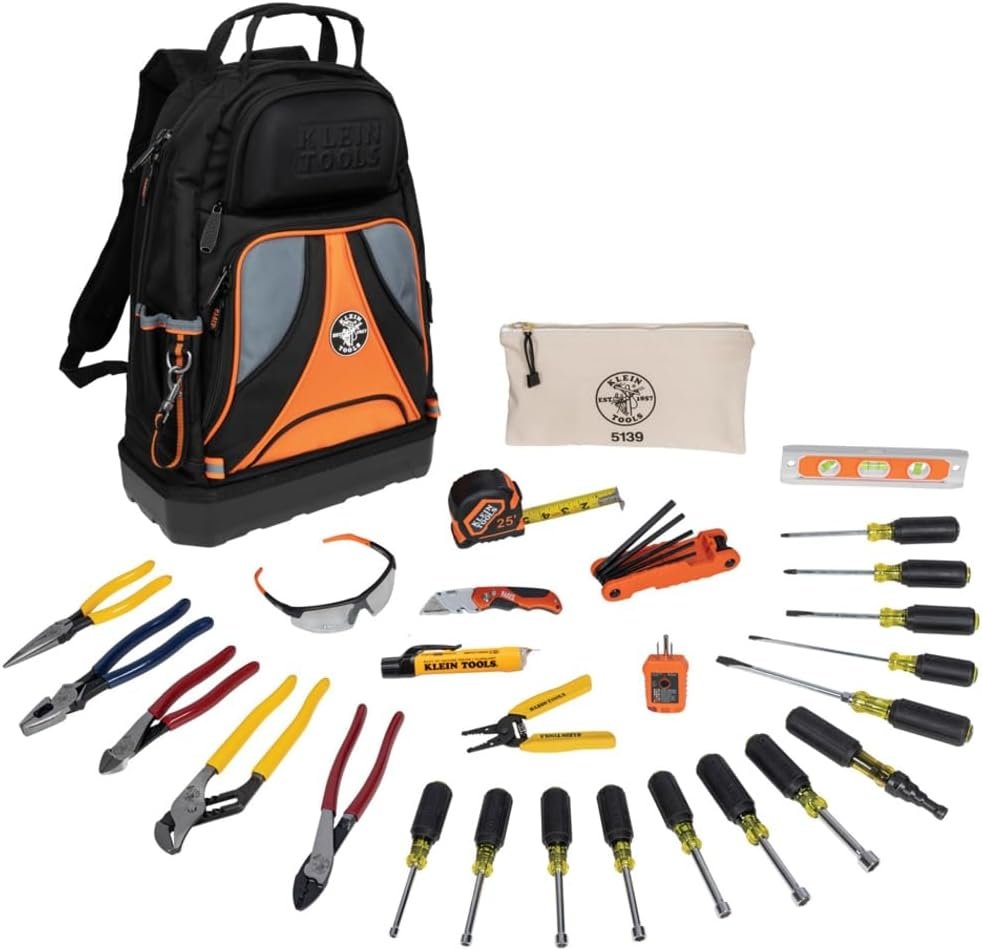
Designed for electricians, apprentices and tradespeople who regularly work on electrical installations, the kit contains 28 pieces, including pliers, screwdrivers, nut drivers, wire preparation tools and two electrical testers.
Rather than relying on a collection of inexpensive interchangeable accessories, Klein has included dedicated tools intended for specific everyday tasks.
The collection is supplied with a 39-pocket Tradesman Pro backpack, providing a practical way to organise and transport equipment between jobs.
For someone assembling a professional electrical toolkit, that combination is particularly appealing.
A well-organised selection of dependable hand tools can make everyday work more efficient. Having the correct screwdriver, pliers or nut driver readily available reduces the need to improvise with equipment that is not suitable for the task.
The Klein 80028 is designed around that principle.
However, this is not a lightweight general-purpose tool bag, and it is not a complete solution for every electrical testing or installation requirement.
The kit weighs approximately 17.25 lb, certain specialised tools are not included, and the hand tools are not insulated for use on live electrical circuits.
Understanding exactly what the kit contains, where it performs best and what additional equipment may be required is essential before choosing it for professional work.
Why it works for professional electricians
Electrical installation work often involves moving between several different operations during the same job.
A technician may need to remove an enclosure cover, check the position of equipment, prepare conductors, tighten terminals and carry out appropriate testing.
Each operation requires a different tool.
A well-chosen kit should provide the essentials without forcing the tradesperson to carry several separate cases.
The Klein Tools 80028 covers a broad selection of these everyday requirements.
Its four types of pliers provide different gripping, cutting and manipulation capabilities.
Six individual screwdrivers cover commonly encountered fastening arrangements, while seven nut drivers provide additional options for hex-head fasteners.
The wire stripper and crimping tool address common cable-preparation tasks.
A torpedo level and tape measure assist with positioning and measuring work.
There are also two electrical testers intended for particular preliminary checks.
Combined with the Tradesman Pro backpack, the tools form a useful starting collection for professional installation and maintenance work.
This makes the kit particularly interesting for apprentices beginning to assemble their own equipment.
Instead of purchasing individual tools without a clear understanding of what is required, they receive a structured selection from an established trade-tool manufacturer.
Experienced electricians may also find the collection useful when preparing a dedicated service bag or replacing an ageing assortment of tools.
However, the contents should still be checked carefully.
A professional electrician’s requirements vary according to the type of work undertaken.
Residential installations, industrial maintenance, commercial construction and specialist electrical testing can all demand different equipment.
The Klein 80028 is best regarded as a substantial collection of frequently used hand tools rather than every tool an electrician will ever need.
Four types of pliers for different tasks
Pliers are among the most frequently used tools in electrical installation work.
A good pair should provide dependable gripping ability, appropriate cutting performance and a comfortable handle for repeated use.
The Klein 80028 includes four different types.
8-inch long-nose side-cutting pliers
Long-nose pliers are useful when working with small components or reaching into confined areas.
Their extended jaws can help grip and manipulate conductors where ordinary combination pliers would be cumbersome.
The integrated side-cutting edges add another function, allowing certain cutting tasks to be performed without immediately changing tools.
These are particularly useful when carrying out detailed installation work where access is restricted.
9-inch linesman’s pliers with fish tape puller
Linesman’s pliers are fundamental equipment for many electricians.
Their broad jaws provide substantial gripping capability, while the cutting edges are intended for demanding everyday electrical work.
The integrated fish tape pulling feature adds a practical advantage when assisting with cable installation.
Rather than using unsuitable gripping surfaces, the feature is designed to help obtain purchase on a fish tape during pulling operations.
8-inch angled-head diagonal cutting pliers
Diagonal cutters are useful for cutting suitable conductors, trimming wire and dealing with other material within the tool’s capacity.
The angled-head design can improve access where a straight approach is inconvenient.
This is valuable around crowded enclosures and other restricted work areas.
Using dedicated cutters also helps avoid damaging the jaws of pliers intended primarily for gripping.
10-inch pump pliers
The pump pliers provide adjustable gripping capability for appropriately sized fittings and components.
Their longer handles and adjustable jaw arrangement make them useful for certain mechanical tasks associated with electrical installation.
They may also be familiar to tradespeople working in plumbing, heating and general maintenance.
However, they are not a substitute for every specialist gripping or fastening tool.
The four types complement one another, making the collection more useful than a kit containing several nearly identical pairs of pliers.
Their value lies in providing different jaw arrangements and functions for different tasks.
Six proper screwdrivers
One of the strongest aspects of this collection is the inclusion of six dedicated screwdrivers.
Klein has not relied exclusively on a single interchangeable-bit handle to cover every fastening requirement.
Instead, the kit includes individual drivers intended for common electrical installation applications.
These consist of:
- A 3/16-inch slotted screwdriver
- A 1/4-inch slotted screwdriver
- A 5/16-inch keystone-tip screwdriver
- A No. 2 Phillips screwdriver
- A No. 2 square-recess screwdriver
- A conduit-fitting and reaming screwdriver
This is a sensible selection.
Different screw heads require correctly shaped drivers.
Using a poorly matched tip can damage the fastener, reduce control or increase the likelihood of slipping.
Dedicated screwdrivers also allow the manufacturer to provide a shaft and handle arrangement suitable for the intended purpose.
The Phillips and square-recess drivers are particularly relevant for commonly encountered electrical fittings.
The slotted screwdrivers provide different blade sizes, allowing the user to choose an appropriate match for the fastener.
The conduit-fitting and reaming screwdriver offers a more specialised function.
It is intended to assist with certain conduit-related installation operations rather than serve merely as another ordinary screwdriver.
For a professional or apprentice electrician, having these tools immediately available can make everyday work more straightforward.
The handles use Klein’s familiar cushioned-grip approach, designed to provide a comfortable holding surface.
However, comfortable grips should not be confused with electrical insulation.
These screwdrivers are not rated as insulated tools for live electrical work.
That distinction is essential, regardless of the appearance or material of the handle.
For normal mechanical operations on appropriately isolated equipment, the dedicated driver selection is a genuine advantage.
Seven nut drivers for common fasteners
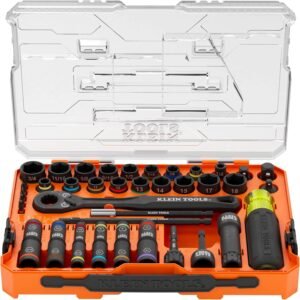
The kit also includes seven individual nut drivers.
These cover the following imperial sizes:
3/16 inch, 1/4 inch, 5/16 inch, 11/32 inch, 3/8 inch, 7/16 inch and 1/2 inch.
Each uses a 3-inch hollow-shaft arrangement.
Nut drivers are particularly useful when tightening or removing suitable hex-head nuts and fasteners.
Unlike an ordinary screwdriver, the tool provides a socket-shaped tip designed to engage the outside of the fastener.
This can offer a convenient method of working on smaller fasteners without reaching for a separate socket set.
The hollow-shaft construction is especially helpful where the threaded stud extends beyond the nut.
Instead of the protruding thread preventing engagement, the shaft provides space for the stud.
This can make the tool practical for appropriate fastening operations in electrical equipment and installations.
A dedicated set also makes size selection straightforward.
The tradesperson can choose the correct driver without searching through loose interchangeable sockets.
However, the sizing deserves attention.
These are imperial nut drivers.
They may not cover the metric fasteners commonly encountered on imported machinery or certain commercial equipment.
Anyone working regularly with metric fittings will need an appropriate additional set.
The included nut drivers are a useful component of the collection, but they should not be assumed to replace a complete socket or fastening system.
Wire stripping and crimping tools
Cable preparation is a routine part of many electrical installation tasks.
Conductors must be prepared carefully so that the correct amount of insulation is removed without damaging the metal beneath.
The Klein 80028 includes a dedicated wire stripper and cutter.
The supplied model is specified for 10–18 AWG solid wire.
Using a correctly sized stripping opening helps reduce the possibility of nicking or weakening the conductor.
This matters because damaged wire can affect the reliability of a termination.
The kit also contains a crimping and cutting tool intended for suitable connectors and conductors within its specified range.
Crimping tools are useful when making approved connections that require a correctly formed mechanical crimp.
However, it is important to match the tool to the connector.
Not every terminal or connector uses the same crimp profile.
Some connections require manufacturer-specific tools, calibrated equipment or particular installation procedures.
The included crimper should therefore be regarded as one useful option rather than a universal solution for every electrical connector.
The same principle applies to wire stripping.
The supplied stripper has a defined working range.
Smaller conductors, larger cables and different conductor types may require additional tools.
For everyday work within the specified capacities, these dedicated tools offer practical convenience.
They also reinforce an important professional principle: cable preparation should be carried out with equipment designed for the material and operation involved.
Electrical testing equipment
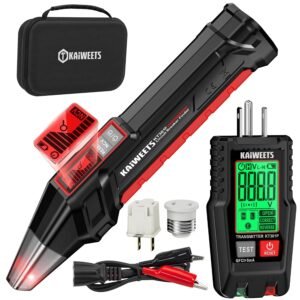
The 80028 kit includes two electrical testers: the Klein NCVT-3P non-contact voltage tester and the RT210 GFCI receptacle tester.
These are useful additions, but their functions must be understood accurately.
The NCVT-3P is a dual-range non-contact AC voltage tester with an integrated flashlight.
It is designed to indicate the possible presence of AC voltage without making direct metallic contact with a conductor.
The two selectable detection ranges allow it to be used for different applications within its specifications.
Klein identifies ranges extending from 12V to 1000V AC in the more sensitive mode and from 70V to 1000V AC in the other mode.
The integrated flashlight can be useful when working around poorly illuminated equipment.
However, a non-contact voltage tester has important limitations.
It cannot establish conclusively that a circuit is safe or de-energised.
Electrical fields can be affected by shielding, nearby materials and other conditions.
The tester also does not detect DC voltage.
For these reasons, the absence of an indication must never be treated as proof that a conductor is safe to touch.
Appropriate isolation procedures and suitable contact-type test equipment are required when verifying that electrical equipment is de-energised.
The RT210 GFCI receptacle tester serves a different purpose.
It is designed for checking certain wiring conditions on compatible receptacles and testing the response of suitable GFCI protection.
Its indicator arrangement helps identify selected common wiring faults.
That can be useful during appropriate preliminary checks.
However, it cannot identify every possible wiring problem.
It also does not replace comprehensive electrical inspection, measurement or verification.
These testers are useful supporting tools, not a substitute for the equipment and procedures required for safe professional electrical testing.
For a technician who understands their capabilities, they add worthwhile functionality to the kit.
Tradesman Pro backpack with 39 pockets
The tool backpack is a major part of the Klein 80028’s appeal.
The supplied Tradesman Pro 55421BP-14 has 39 pockets designed to organise a substantial selection of hand tools and accessories.
A conventional open tool bag can become difficult to manage when screwdrivers, pliers and smaller components collect together at the bottom.
The backpack takes a more structured approach.
Its interior pockets allow different tools to be stored in defined positions.
This can make it easier to locate the correct screwdriver or pair of pliers without removing several unrelated items.
Klein uses a bright orange interior, providing a useful contrast against darker tools.
That may help when working in poorly lit environments.
The backpack also has a hard, moulded front pocket intended to protect safety glasses.
This is a thoughtful feature because protective eyewear can easily become scratched or damaged when carried loose among metal tools.
A separate front pocket provides additional storage for smaller accessories.
The main body is constructed from a durable 1680-denier material, while the base is moulded to help protect the contents when the bag is placed on the ground.
Padded shoulder straps make it possible to carry the equipment on the back rather than relying entirely on one hand.
That can be especially useful when moving between buildings, climbing stairs or carrying other equipment.
The backpack is water-resistant, but it should not be treated as completely waterproof.
Sensitive electrical equipment and documents still require appropriate protection in heavy rain or persistently wet conditions.
Overall, the backpack adds genuine practical value rather than serving merely as packaging for the tools.
What it feels like to use on site
A tool kit should be judged not only by the number of items included but also by how easily those tools can be accessed during everyday work.
The Klein 80028 offers a conventional collection of hand tools supported by organised storage.
For installation work, that could make a noticeable difference.
A technician carrying out routine tasks may need to alternate between measuring, positioning, cutting and fastening.
If each tool has a consistent storage position, less time is spent searching through the bag.
The backpack format also allows both hands to remain available while carrying equipment between work areas.
This is particularly helpful where a tradesperson needs to use handrails or carry materials separately.
Once the bag is opened, the numerous pockets provide opportunities to organise the tools according to frequency of use.
Frequently used screwdrivers and pliers can be positioned where they are easier to reach.
Less frequently used items can occupy other compartments.
The additional canvas zipper pouch is useful for small items that might otherwise become lost among larger tools.
However, the arrangement still requires discipline.
A backpack with 39 pockets will not remain organised if tools are returned randomly after each operation.
The user needs to establish a sensible layout.
For professionals who already have a preferred working routine, that should be straightforward.
Apprentices may find the structured storage particularly useful when developing good tool-handling habits.
The result is a kit that encourages organisation, though it does not eliminate the need for it.
Useful for apprentices and experienced tradespeople
The 80028 occupies an interesting position because it can suit people at different stages of their careers.
For an apprentice electrician, it offers a substantial starting collection.
The kit includes many of the hand tools likely to be encountered during ordinary installation and maintenance tasks.
It also introduces the user to dedicated professional tools rather than relying on a small collection of improvised alternatives.
That can help build familiarity with correct tool selection.
Learning to choose the appropriate screwdriver, cutting tool or nut driver is an important part of developing sound working habits.
The included backpack gives the apprentice a practical way to transport and protect the equipment.
For an experienced electrician, the attraction may be different.
Someone who already owns a large workshop collection might want a dedicated bag for particular service work.
Another tradesperson may be replacing equipment that has become worn or difficult to organise.
The Klein kit provides a consistent group of tools without requiring every item to be selected separately.
It may also appeal to professionals working across several building services.
Heating, ventilation, maintenance and general mechanical work often involve basic electrical-related fastening and cable-management tasks.
However, appropriate trade qualifications and safe working procedures remain essential.
Owning electrical tools does not automatically make someone competent to undertake electrical installation or testing work.
The kit provides equipment; it does not replace training or professional judgement.
The smaller tools and accessories
Beyond the principal pliers and drivers, Klein includes several additional items.
The 25-foot tape measure provides a familiar means of taking dimensions during installation work.
Accurate measurement is important when positioning equipment, planning routes or checking available space.
The 9-inch aluminium torpedo level is useful for checking the alignment of suitable fixtures, enclosures and fittings.
Its compact form makes it easier to carry than a full-length spirit level.
The kit also includes a folding hex-key set.
This provides another fastening option for components using compatible hex-socket screws.
A folding utility knife supports appropriate general cutting tasks.
As with any cutting tool, it requires careful handling and should only be used for operations within its intended capability.
The protective eyewear provides a convenient addition to the collection.
However, the user must still ensure that the eyewear is appropriate for the hazards involved in the actual task.
Finally, the canvas zipper pouch provides a useful place for smaller items and accessories.
Taken individually, these pieces may appear less important than the pliers or screwdrivers.
Together, they make the kit more complete for everyday site work.
They also reinforce its role as an organised tool collection rather than simply a group of individual hand tools supplied in a box.
The drawbacks
The Klein Tools 80028 has several important strengths, but it also has limitations that should be understood before choosing it for professional use.
The most important drawback is that the hand tools are not insulated for live electrical work.
This is essential information.
Although the kit is intended for electricians, Klein explicitly warns that the hand tools are not insulated and must not be used on or near live electrical circuits.
The presence of cushioned handles does not change that warning.
A plastic or rubber-style grip is not necessarily an electrically rated insulating barrier.
Tools intended for specialised electrical work may carry specific insulation markings and standards.
Those markings should never be assumed simply because a handle looks protective.
The Klein 80028 is therefore not a substitute for an appropriate set of rated insulated tools where such equipment is required.
Safe electrical work depends on proper isolation, appropriate testing, suitable equipment and the competence of the person carrying out the task.
For an electrician who needs insulated hand tools as part of their regular work, additional purchases will be necessary.
This is not a minor detail.
It is a fundamental limitation that every prospective buyer should understand.
The supplied non-contact voltage tester cannot prove that a circuit is dead.
The NCVT-3P can be useful for detecting the possible presence of AC voltage.
However, a non-contact tester is not a complete electrical safety instrument.
It may fail to indicate voltage under certain conditions.
Shielded conductors, grounded metal enclosures, differences in insulation and other factors can affect its operation.
It also does not detect DC voltage.
Therefore, the absence of a warning from the tester cannot be treated as confirmation that a circuit is de-energised.
Appropriate contact-type instruments and established verification procedures are required when proving the absence of hazardous voltage.
Klein also instructs users to check the tester against a known live circuit before and after use.
Anyone relying exclusively on a non-contact tester to determine whether conductors are safe to handle would be using the equipment incorrectly.
The inclusion of the NCVT-3P is useful, but it does not make the 80028 a complete electrical testing kit.
The GFCI receptacle tester has a limited diagnostic role.
The RT210 is designed to identify selected common wiring conditions at compatible outlets and check certain GFCI functions.
That can be useful during preliminary inspection.
However, it cannot detect every possible fault.
Multiple wiring problems may produce misleading indications, and certain grounding issues cannot be fully assessed by an ordinary plug-in tester.
The device is also designed around compatible receptacle arrangements.
It cannot be used as a universal electrical tester for every installation.
Professional verification may require measurements and procedures well beyond the capabilities of this instrument.
A buyer should therefore see the RT210 as a convenient additional tool rather than a replacement for appropriate electrical testing equipment.
The kit is substantial to carry.
Klein specifies a total weight of approximately 17.25 lb, or 7.8 kg.
That is a considerable amount of equipment before any additional tools or materials are placed in the backpack.
For short journeys between a vehicle and a work location, this may be entirely manageable.
However, a tradesperson carrying the bag throughout a large building or regularly climbing several flights of stairs may notice the weight.
The backpack has padded shoulder straps, but padding does not remove the physical load.
Additional equipment such as drills, batteries, meters and consumables will make the complete carrying weight greater.
For someone who prefers a compact service bag containing only the essentials for a particular task, the 80028 may be unnecessarily bulky.
A smaller, carefully selected toolkit could be more comfortable.
The decision depends on whether the convenience of carrying a broad selection outweighs the additional weight.
Some experienced electricians will already own many of the tools.
This is another practical consideration.
An apprentice beginning with very little equipment may benefit from purchasing a complete set.
An experienced tradesperson may already have preferred screwdrivers, pliers, cutters and measuring tools.
In that situation, buying the 80028 could result in substantial duplication.
The included equipment may be perfectly capable, but duplicate tools do not necessarily improve productivity.
They still require storage and maintenance.
For someone who already owns most of the collection, purchasing only the missing items may be more sensible.
The full kit is strongest when a considerable proportion of its contents will genuinely be used.
The 28-piece description can create misleading expectations.
The kit contains 28 pieces, but they are not all individual working hand tools.
The total includes items such as the backpack, canvas pouch and protective eyewear.
That is perfectly legitimate, but it matters when comparing the collection with other advertised tool sets.
A kit described as containing dozens of pieces may include accessories and storage components as part of the total.
The important question is not simply how many pieces are advertised.
It is which tools are included, whether their specifications are appropriate and how useful they will be in practice.
Buyers should examine the contents rather than choosing the largest advertised number.
The wire stripper has a defined conductor range.
The included stripper is intended for 10–18 AWG solid conductors.
This covers a useful range of applications, but it does not cover every conductor an electrician may encounter.
Smaller control wires, larger cables and different conductor constructions may require other tools.
Using an unsuitable stripping opening can damage the conductor.
The fact that a wire fits between the jaws does not automatically mean the tool is suitable.
Professionals working across varied cable types may therefore need several different stripping tools.
The supplied model is valuable within its specified range, but it should not be regarded as universal.
The crimping tool will not suit every connector.
Electrical connectors vary considerably.
Some require a particular crimp profile, approved tool or installation procedure.
The crimper supplied with the 80028 cannot cover every connection system.
For specialist terminals, larger conductors or manufacturer-specific connections, additional equipment may be necessary.
This is important because an incorrectly formed crimp can produce an unreliable connection.
A tradesperson should always follow the connector manufacturer’s requirements.
The included crimping tool is a useful general addition, but it does not remove the need for specialised equipment where specified.
The nut drivers use imperial sizes.
The seven supplied nut drivers cover common imperial fasteners.
However, many machines, appliances and commercial installations use metric sizes.
An imperial driver should not be forced onto a metric fastener simply because it appears close in size.
Doing so may damage the tool or fastener.
Someone working frequently with metric equipment may require an additional nut-driver or socket set.
This is particularly relevant in environments containing machinery from different manufacturers and regions.
The supplied selection makes sense for many American installation applications, but it is not universally suitable.
The backpack takes up considerable space.
The Tradesman Pro backpack is designed to carry a substantial number of tools.
Its moulded base and structured shape provide useful protection and organisation.
However, this also means the bag occupies a defined amount of space even when it is not completely full.
In cramped service cupboards, small plant rooms or crowded work vehicles, its size may be inconvenient.
A soft tool roll or compact open-top bag could be easier to position in certain environments.
The backpack design is strongest when the user needs to move between jobs with a broad selection of equipment.
For work carried out in one small location, it may be less convenient.
The 39 pockets do not guarantee perfect organisation.
A large number of pockets sounds attractive, but it can also create its own problems.
The user must decide where each tool belongs.
Some pockets may be too narrow for particular items, while other compartments may remain unused.
Smaller accessories can become difficult to locate if they are placed randomly.
The backpack is also supplied with tools of different lengths and shapes.
Finding an effective arrangement may require experimentation.
Once organised, the bag should work well for a consistent routine.
However, a backpack cannot compensate for careless tool storage.
Professionals who prefer very simple layouts may find a bag with fewer compartments more convenient.
The backpack is water-resistant, not waterproof.
Klein uses durable material and a moulded bottom to help protect the contents.
These features are useful on building sites and during ordinary transport.
However, water resistance does not mean that equipment can remain safely exposed to heavy rain or standing water.
Moisture can still enter through openings or zippers.
This matters particularly when carrying electrical testers and other moisture-sensitive equipment.
Appropriate additional protection may be required in wet conditions.
The moulded base should not be treated as permission to place the backpack in water or leave it outdoors for extended periods.
A backpack is not always the most convenient working bag.
Backpacks are excellent for carrying equipment.
They leave both hands available while walking and can distribute weight across the shoulders.
However, they are not always as convenient as an open tool tote once work begins.
The user may need to set the bag down, open the compartments and locate the correct tool.
In a confined area, there may not be enough space to open the backpack fully.
For technicians who constantly move between very small jobs, a simple open-top bag can sometimes provide faster access.
The Klein backpack is a practical transport system, but its suitability depends on the working environment.
The kit does not include every specialist electrical tool.
Despite its extensive contents, the 80028 is not a complete collection for every installation task.
It does not replace a suitable multimeter, specialised voltage tester, insulation resistance tester or other equipment required for particular electrical inspections and measurements.
It also does not include every cable cutter, conduit tool, drill, torque-controlled driver or specialised installation accessory.
These omissions are understandable.
No sensible portable toolkit can include every item used across all branches of electrical work.
Nevertheless, someone purchasing the 80028 as their first professional collection should understand that further equipment will almost certainly be required.
The appropriate additions will depend on training, the employer’s requirements and the work being undertaken.
There is no dedicated torque-control solution in the kit.
Many electrical connections have manufacturer-specified tightening requirements.
Ordinary screwdrivers and nut drivers provide manual control, but they do not measure the torque being applied.
Overtightening can damage components.
Insufficient tightening can also create unreliable connections.
Where a manufacturer specifies a tightening torque, an appropriate torque-controlled tool may be necessary.
The 80028 does not replace that equipment.
This is an important consideration for anyone working regularly on connections where precise tightening is required.
The protective eyewear must still match the task.
The included safety glasses are a welcome addition.
However, not every form of protective eyewear is suitable for every workplace hazard.
Cutting, drilling, grinding and other operations may require different types or levels of protection.
The user must assess the actual working conditions and follow applicable safety requirements.
The supplied glasses should not automatically be assumed to provide sufficient protection for every task.
Personal protective equipment must always be selected according to the hazard involved.
The kit may be more than a casual user needs.
For someone undertaking occasional household maintenance, 28 pieces of trade-oriented equipment and a large backpack may be excessive.
A smaller collection of high-quality tools could be more appropriate.
The Klein 80028 makes most sense when its tools will be used frequently enough to justify their storage and carrying requirements.
Its attraction is professional usefulness rather than the novelty of owning a large collection.
For a person who only occasionally tightens a fitting or performs simple non-electrical maintenance, much of the equipment may remain unused.
Finally, owning the tools does not replace electrical competence.
The presence of testing equipment and specialised electrical hand tools may make the kit appear suitable for a broad range of electrical operations.
However, electrical work involves hazards that cannot be controlled simply by choosing a reputable tool brand.
Safe work requires correct procedures, suitable testing instruments, proper isolation and relevant professional competence.
Some work is subject to legal and regulatory requirements.
The Klein 80028 is a collection of tools intended to support appropriate tasks.
It does not provide the training, authorisation or verification procedures required to carry out electrical work safely.
For a professional, that distinction should be obvious.
For an apprentice or less experienced buyer, it is an important point to understand from the beginning.
Who it suits best
The Klein Tools 80028 Electrician Tool Kit is particularly suitable for apprentice electricians who want to begin building a dependable collection of professional hand tools.
The included pliers, screwdrivers, nut drivers and cable-preparation equipment provide a useful foundation for learning everyday installation tasks.
The Tradesman Pro backpack also encourages sensible tool organisation and makes the collection easier to transport.
Experienced electricians may appreciate the kit when assembling a dedicated service bag or replacing several worn tools at the same time.
It could also appeal to general maintenance professionals who regularly need high-quality hand tools alongside basic electrical checking equipment.
However, the collection is less suitable for someone who already owns most of its contents or requires a lightweight bag for only a few specialised tasks.
It is also not intended to replace properly rated insulated tools, comprehensive electrical test equipment or the training necessary for safe work.
The strongest audience is the tradesperson who genuinely needs a broad, organised collection of frequently used professional tools.
Is it worth the workshop and site space?
The Klein Tools 80028 Electrician Tool Kit offers a substantial collection of professional equipment in a well-organised carrying system.
Its greatest strength is the balance between general-purpose hand tools and items specifically selected for electrical installation work.
Four different types of pliers, six dedicated screwdrivers and seven nut drivers provide a useful foundation for everyday fastening and handling tasks.
The wire stripper, crimping tool, measuring equipment and electrical testers add further practical value.
The 39-pocket Tradesman Pro backpack is an important part of the package, offering organised storage and a convenient way to transport the collection between jobs.
There are genuine limitations.
The complete kit is relatively heavy, some experienced professionals will already own many of the tools, and additional specialist equipment may be required.
Most importantly, the hand tools are not insulated for live electrical work, while the included testers have clearly defined capabilities and limitations.
These considerations should form part of the buying decision.
Nevertheless, for an apprentice or tradesperson who needs a substantial selection of dependable hand tools, the Klein 80028 offers an attractive starting point.
Rather than concentrating on unnecessary features, it combines familiar professional tools with practical storage and useful accessories.
For someone who values proper individual hand tools, organised equipment and established trade-oriented design, the Klein Tools 80028 is certainly worth considering.
For more professional electrical testing equipment, installation tools and practical trade essentials, explore our Electrical & Testing guides.
As an Amazon Associate I earn from qualifying purchases.