KAIWEETS KT301P Circuit Breaker Finder
As an Amazon Associate I earn from qualifying purchases.
Finding the correct breaker can be unnecessarily time-consuming when a consumer unit or panel is poorly labelled. A circuit breaker finder gives electricians and service technicians a quicker way to trace an outlet or circuit back to the correct breaker.
The KAIWEETS KT301P combines circuit identification with outlet testing, NCV detection and a selection of adapters, giving it a broader role than a simple breaker tracer.
Why it makes sense for electrical fault finding
The KAIWEETS KT301P makes sense when you need to identify a circuit quickly without repeatedly switching breakers and walking back and forth between the panel and the outlet.
The transmitter and receiver work together to narrow down the correct breaker, while the outlet-testing and NCV functions give the kit a little more day-to-day usefulness than a single-purpose tracer.
For electricians, maintenance engineers and property service work, that can make it a handy tool for older installations, poorly labelled panels and general fault finding.
What it should feel like to use
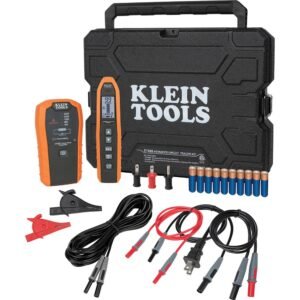
The KAIWEETS KT301P should feel more like a compact diagnostic kit than a single-purpose tester. The receiver is designed to be easy to carry around a panel, while the transmitter and adapters stay together in the case rather than ending up loose in the tool bag.
The LCD display and audible indication should make it easier to narrow down the correct breaker without relying on guesswork alone, and the extra outlet-testing and NCV functions add some useful flexibility for service work.
The main practical advantage is convenience. Instead of moving repeatedly between the panel and the outlet, the tool gives you a more direct way to identify the circuit, particularly in buildings where labelling is poor or incomplete.
The drawbacks
The main drawback with the KAIWEETS KT301P is that a breaker finder should never be treated as a substitute for proper electrical verification. It can help identify the likely circuit, but safe isolation still needs to be confirmed with the appropriate test equipment before work begins.
Circuit tracing can also be affected by the installation itself. Shared wiring, electrical noise, closely grouped conductors and older or unusual circuit layouts can make identification less straightforward than it appears in a clean demonstration.
The extra functions are useful, but they also make the kit more complex than a basic tracer. Someone who only needs to identify breakers occasionally may find a simpler unit easier to live with.
There is also the question of brand confidence. KAIWEETS offers a lot of functionality for the money, but it does not carry the same long-established professional reputation as Fluke or Klein. For heavy daily use, some electricians may prefer to pay more for equipment from a brand they already trust.
Finally, this is a specialist diagnostic tool. If your panels are already clearly labelled and you rarely trace circuits, it may spend more time in the case than in your hand.
Who it suits best
The KAIWEETS KT301P is best suited to electricians, maintenance engineers and service technicians who regularly need to trace circuits in properties where labelling is poor, incomplete or unreliable.
It makes particular sense for fault finding, property maintenance and renovation work, where identifying the correct breaker quickly can save a lot of unnecessary back-and-forth.
It is less suitable for users who rarely need to trace circuits, or for anyone who already carries a more advanced professional circuit tracer that covers the same job.
Is it worth a place in the electrical tool kit?
For electricians and maintenance engineers who regularly work in buildings with poor or missing circuit labels, the KAIWEETS KT301P can earn its place by making circuit identification quicker and less tedious.
Its main strength is convenience. The combination of breaker finding, outlet testing and NCV detection gives it more usefulness than a very basic tracer, while the case keeps the different parts together.
The compromise is that it should always be treated as an aid rather than the final word. Proper electrical verification still matters, and anyone doing heavy daily tracing work may prefer equipment from a more established professional test brand.
For general service and maintenance work, though, it is a practical addition to the kit.